How to Start a Pre Roll Company
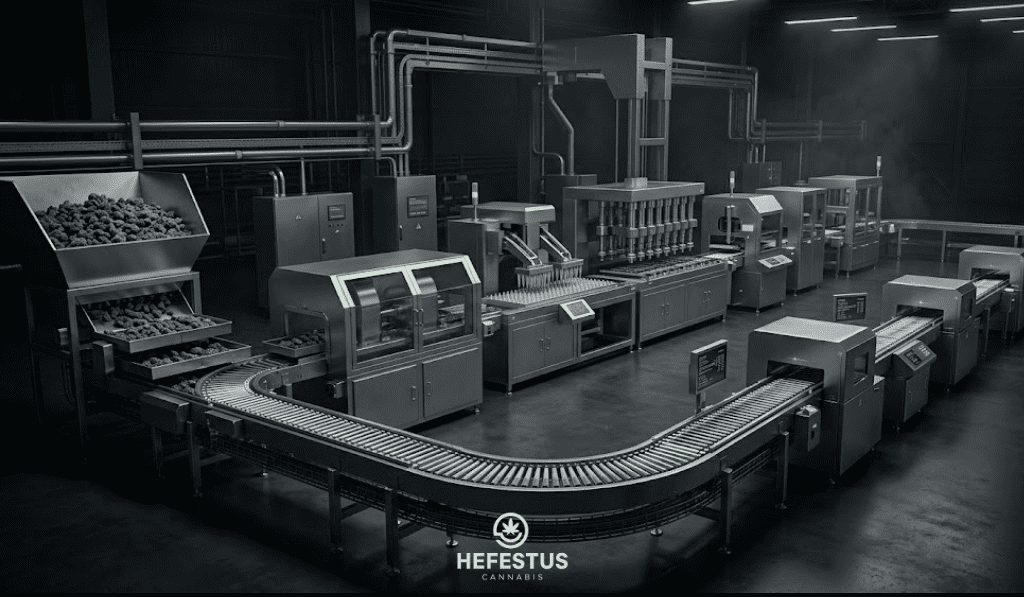
Pre-rolls are no longer a niche convenience product. They are now one of the top-selling SKUs on dispensary shelves across every legal cannabis market in the United States — and the companies that manufacture them at scale are positioned to capture an enormous share of an industry still in its growth phase.
According to data from Headset, pre-rolls accounted for roughly 14% of all cannabis sales by 2024, making them the second-largest product category behind flower. BDSA market research projects the global cannabis pre-roll market will surpass $10 billion by 2030. Dispensaries actively seek reliable suppliers who can deliver consistent, compliant, well-branded products — week after week, batch after batch.
But this is not an easy industry to enter. The regulatory complexity is real. The margins are tight. And the operational demands of producing pre-rolls at scale require strategic planning before you touch a single gram of cannabis.
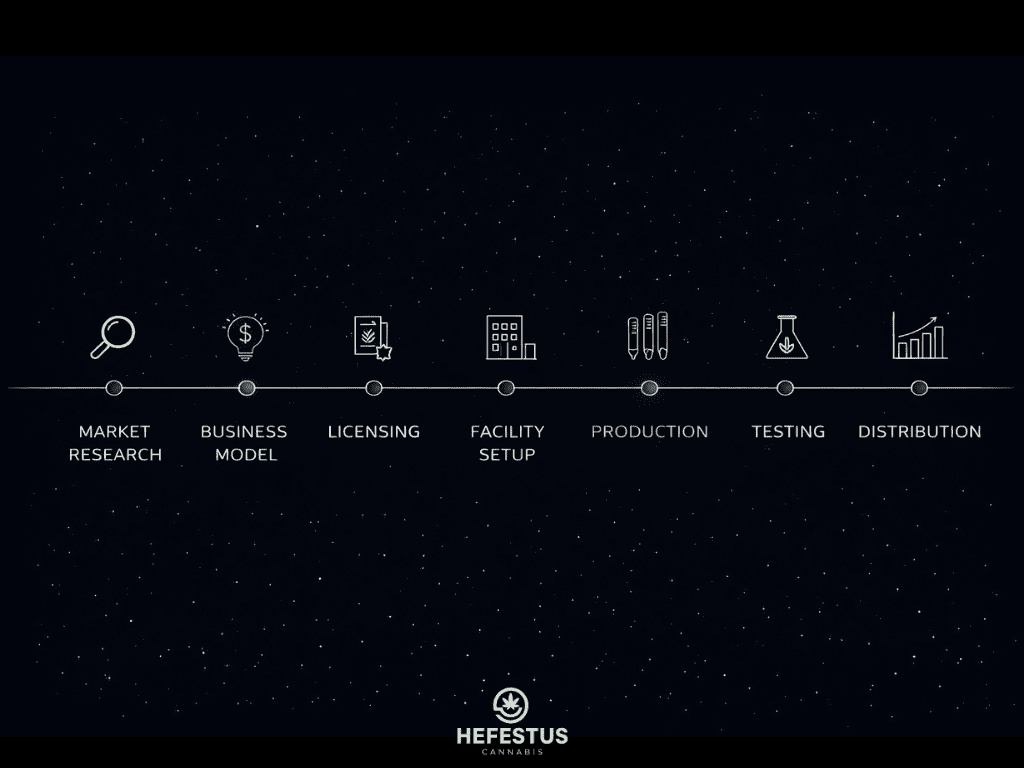
This guide covers exactly how to start a pre-roll company — from choosing your business model and securing the right licenses, to building an efficient production line and getting your products onto dispensary shelves.
The Pre-Roll Market Opportunity
The growth trajectory of pre-rolls outpaces almost every other cannabis format. Between 2020 and 2024, pre-roll sales grew at a compound annual growth rate (CAGR) of over 20% according to Headset’s category trend reports. Several converging factors are driving this demand:
- Convenience: Pre-rolls require no equipment, no preparation, and no rolling skill — eliminating friction for new consumers.
- Consistent dosing: Each unit delivers a predictable experience, which matters especially to medical cannabis patients.
- Infused innovation: The fastest-growing sub-segment is infused pre-rolls — joints enhanced with hash, rosin, live resin, distillate, or kief — commanding $15 to $40+ per unit at retail.
- Gifting and social use: Pre-rolls are among the most popular cannabis gifts and are well-suited to social consumption, expanding their market beyond solo users.
The infused pre-roll segment alone grew over 50% year-over-year in several state markets between 2022 and 2024 per Headset data. If you are entering this space, understanding these category dynamics is the difference between launching a product that moves and launching one that sits.
Choosing Your Pre-Roll Business Model
Before you file a single permit or buy a single machine, you need to decide what type of pre-roll company you are building. There are two fundamental paths, and the one you choose will determine your licensing requirements, startup costs, target customers, and operational structure.
Option 1: Branded Pre-Roll Company
You develop your own cannabis brand — your own strain lineup, packaging, identity, and retail presence. You source flower, produce pre-rolls under your label, and sell directly to dispensaries. This path demands stronger marketing investment and brand-building, but the upside is brand equity and higher margin potential over time.
Option 2: Contract Manufacturer
You operate as a behind-the-scenes production facility, rolling pre-rolls for other cannabis brands. Your customers are brands that want outsourced manufacturing. The margins are thinner, but the sales cycles are simpler and you avoid the costs of brand development. This is often the faster path to revenue for operators with strong production capabilities.
Some companies do both — starting as contract manufacturers to fund operations, then building out their own brand as revenue stabilizes. Choose your model intentionally from day one, because it determines everything downstream.
Licensing and Legal Requirements
Cannabis licensing is the single most complex and time-consuming step in starting a pre-roll company. Every state operates under its own regulatory framework — what applies in Colorado does not apply in California, Michigan, or Illinois. There is no federal license to obtain; cannabis remains a Schedule I controlled substance under federal law, meaning all legal operations happen at the state level.
Manufacturing License
Pre-roll production is classified as cannabis manufacturing in most states. You will need a manufacturing or processing license from your state’s cannabis regulatory body — such as the California Department of Cannabis Control (DCC) or the Colorado Marijuana Enforcement Division (MED). Application fees alone can run from $5,000 to $50,000+ depending on the state and license tier.
Local Business Permit and Zoning Approval
Most municipalities require a local cannabis business permit in addition to the state license. Your facility must be located in a properly zoned area for cannabis processing. Many cities prohibit cannabis facilities within a certain distance of schools, parks, or places of worship. Check both state and municipal zoning codes before signing a lease.
Facility Inspection and Compliance
Before you can operate, your facility will undergo inspection by state regulators — and in some jurisdictions, multiple agencies. You may be required to submit architectural site plans, install odor mitigation systems, and demonstrate compliant security infrastructure including cameras, access logs, and alarm systems.
Testing Requirements
Every batch of pre-rolls must be tested by a state-accredited third-party laboratory for potency (THC/CBD content), residual solvents, pesticides, heavy metals, and microbial contamination including mold and mildew. Failing a batch means lost product and revenue. Build testing costs and timelines into your production plan from the start.
Pro tip: Hire a cannabis compliance attorney before submitting your first license application. Mistakes in the application process can delay licensing by months. The cost is far less than the cost of a rejected or delayed application.
How Pre-Rolls Are Produced: The Full Workflow
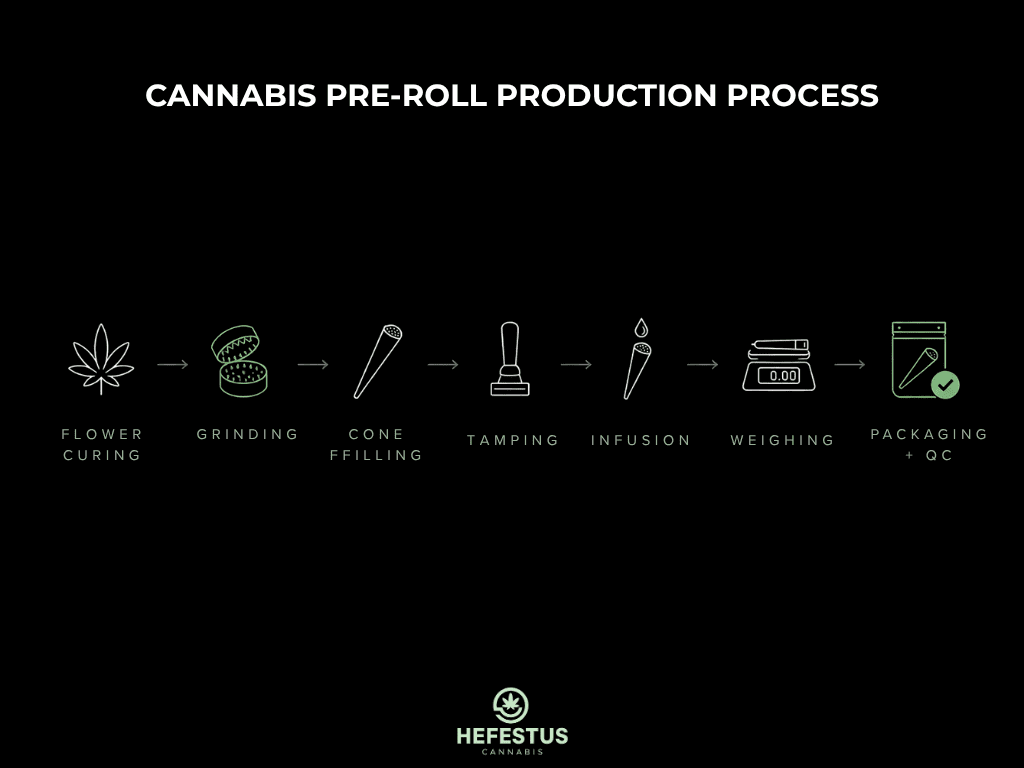
Understanding how to produce pre-rolls at a commercial level is essential before you invest in equipment or build out a facility. Here is the end-to-end production workflow:
1. Flower Preparation: Curing and Trimming
Quality starts with the input material. Flowers must be properly cured — typically 2 to 4 weeks post-harvest — to achieve the right moisture content for grinding. Incorrectly cured cannabis burns poorly, tastes harsh, and leads to inconsistent rolls. Trim away excess stems and fan leaves before grinding.
2. Grinding: Particle Consistency for Airflow
The grind is more technical than most people realize. Too fine and the pre-roll burns too hot and draws with resistance. Too coarse and it burns too fast and runs unevenly. Industrial grinders allow you to dial in particle size for optimal airflow and combustion. Consistent grind size is one of the most important quality variables in production.
3. Cone Filling: Manual vs. Automated
Cones are pre-rolled paper tubes that are filled with ground cannabis. At a small scale, filling can be done manually using a cone-filling tray. At commercial scale, automated cone-filling machines can fill hundreds to thousands of cones per hour with consistent density. The choice of paper matters too — unbleached, natural papers provide a cleaner taste profile and appeal to quality-conscious consumers.
4. Packing and Tamping
After filling, each pre-roll is tamped to remove air pockets and ensure uniform density from tip to base. Under-packed joints burn unevenly and canoe. Over-packed joints are difficult to draw. Automated tamping systems maintain consistent pack density across thousands of units.
5. Optional: Concentrate Infusion
Infused pre-rolls involve coating the outside of the joint with a concentrate (such as distillate or live resin) and then rolling it in kief or hash. This dramatically increases potency and retail price. Infusion requires additional equipment and increases production time, but infused products currently command the highest retail margins in the pre-roll category.
6. Weighing and Quality Control
Every finished pre-roll is weighed to ensure it meets the declared weight on the label. Batch-level quality checks verify pack density, visual appearance, and cone integrity. Any units outside tolerance are rejected. Digital scales integrated with production software can automate this step and generate batch records required for state compliance.
7. Packaging
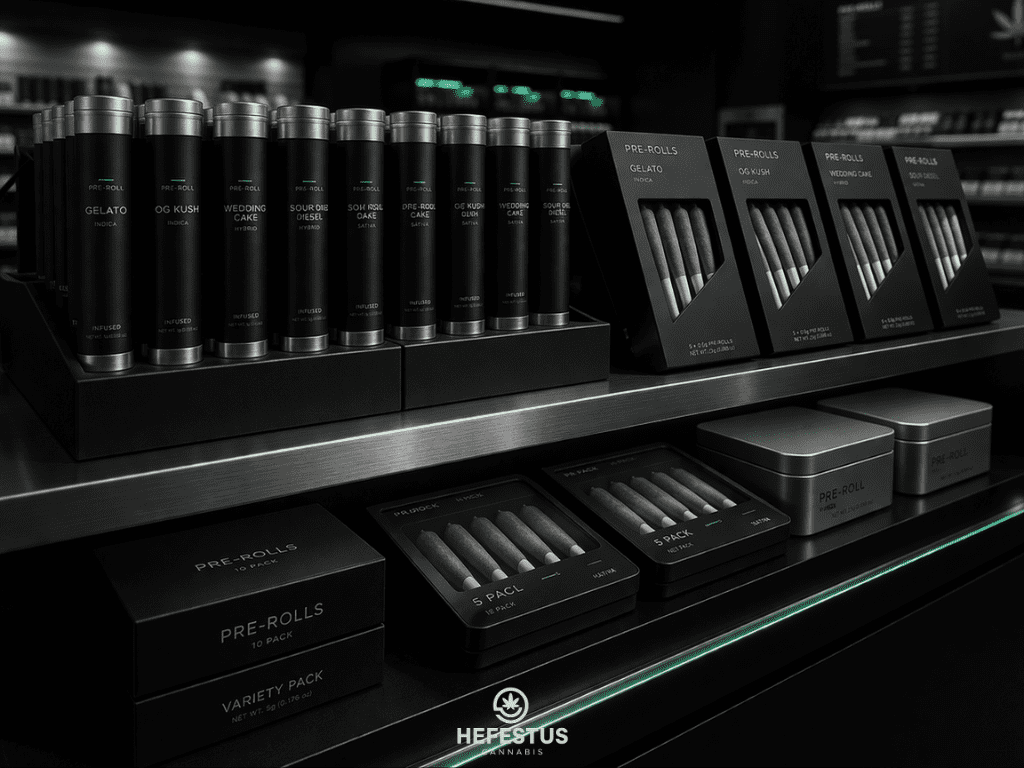
Child-resistant packaging is mandatory in all legal cannabis markets in the U.S. Pre-rolls are typically sold in individual tubes, 2-packs, or multi-packs of 5 to 10 joints. Packaging must display required state compliance information including strain name, THC/CBD content, batch number, test date, license number, and health warnings. Beyond compliance, packaging is a primary brand touchpoint — invest in design that communicates your brand identity clearly.
Equipment Needed to Start a Pre-Roll Company
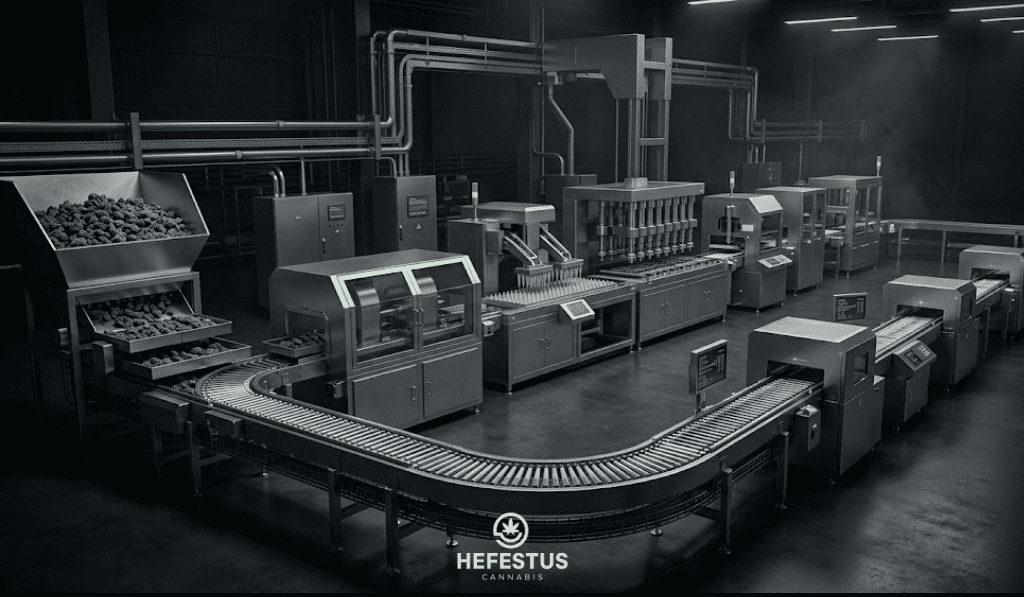
The equipment you invest in determines your production capacity and product quality. Core machinery every pre-roll manufacturer needs:
- Industrial grinders — ensure consistent particle size across large batches
- Cone-filling machines — range from manual tray-based systems to fully automated multi-head machines
- Tamping and closing equipment — ensures uniform pack density and seals each cone
- Precision weighing systems — digital scales with batch logging for QC and compliance documentation
- Packaging equipment — tube-filling, labeling, and bundling systems for retail-ready output
- Infusion equipment (optional) — applicators and coating systems for concentrate-infused products
| Production Method | Pre-Rolls Per Hour | Typical Use Case |
| Manual rolling / tray filling | 50–100 | Craft, startup, or specialty batches |
| Semi-automated filling machine | 500–1,000 | Small-to-mid scale operations |
| Fully automated industrial line | 3,000–10,000+ | High-volume commercial production |
Investing in automation early — even at the semi-automated level — dramatically reduces labor costs, improves consistency, and allows you to scale without proportional headcount increases.
Startup Costs for a Pre-Roll Company
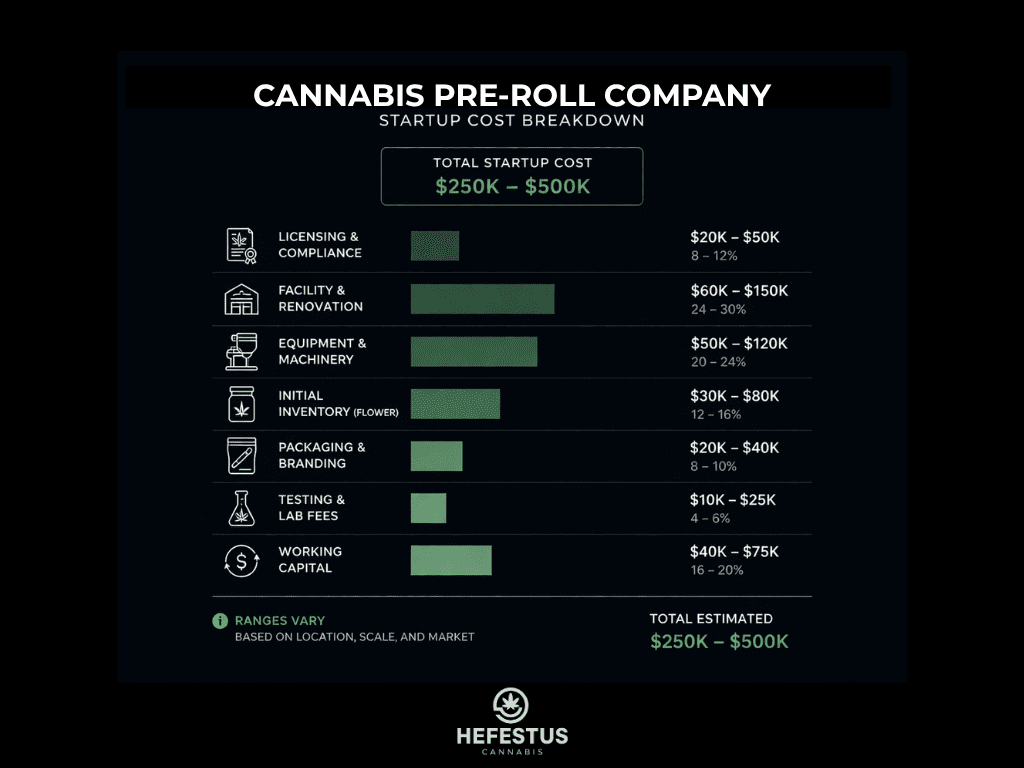
One of the most common mistakes new cannabis entrepreneurs make is underestimating startup costs. Here is a realistic breakdown of what to budget before your first pre-roll reaches a dispensary shelf:
| Cost Category | Estimated Range | Notes |
| Licensing & legal | $10,000–$100,000+ | State application fees, attorney fees, background checks |
| Facility (lease + build-out) | $50,000–$500,000 | Zoning-compliant space, security, odor control |
| Equipment | $25,000–$250,000 | Grinders, filling machines, packaging systems |
| Initial cannabis inventory | $10,000–$75,000 | Depends on production volume and sourcing model |
| Packaging & materials | $5,000–$50,000 | Cones, tubes, labels, child-resistant packaging |
| Testing (per batch) | $500–$2,000 per batch | Third-party lab testing, mandatory in all states |
| Working capital buffer | $25,000–$100,000 | Reserve for net-30/60 dispensary payment cycles |
Important: IRS Section 280E prohibits cannabis businesses from deducting most normal business expenses on federal taxes because cannabis remains federally illegal. This significantly increases your effective tax burden compared to other industries. Work with a CPA who specializes in cannabis taxation before setting your pricing model.
On top of taxes, most traditional banks will not accept cannabis business accounts. You will likely need to work with a cannabis-friendly credit union or fintech provider — and pay higher fees for the privilege. Factor this into your operational budget.
Scaling Pre-Roll Production
Most pre-roll companies start with manual or semi-automated production and scale into industrial automation as demand grows. Knowing when to make that transition is critical.
Manual production hits a ceiling quickly. Once you are producing more than 1,000 units per day, labor costs and inconsistency become significant problems. Human rolling introduces variability in weight, pack density, and finish quality that accumulates across batches — and inconsistency at scale means complaints, returns, and brand damage.
Signs it is time to invest in automated production:
- Labor costs exceed 35–40% of production cost per unit
- Quality control rejects are increasing as volume rises
- You are turning down dispensary orders due to capacity constraints
- A single key employee’s absence disrupts your entire production schedule
Industrial cone-filling machines can produce 3,000 to 10,000+ pre-rolls per hour with consistent weight and density. The ROI on automation typically becomes clear within 12 to 18 months at commercial production volumes.
Distribution and Retail Strategy
Getting your pre-rolls manufactured is only half the battle. Getting them into dispensaries — and keeping them there — requires a focused distribution and retail strategy.
Working with Licensed Distributors
In most states, cannabis products must move through a licensed distributor before reaching a retail dispensary. Your distributor handles transportation, compliance documentation, and often serves as a liaison to retail buyers. Choose distribution partners carefully — a distributor with strong existing dispensary relationships can dramatically accelerate your retail placement.
Seed-to-Sale Tracking Compliance
State-mandated seed-to-sale tracking systems — primarily Metrc (used in California, Colorado, Michigan, and many others) and BioTrack (used in Washington and a handful of other states) — require you to log every gram of cannabis from cultivation through final sale. Every transfer, every batch, every package must be scanned and recorded in real time. Build this compliance workflow into your operations from day one.
Dispensary Relationships and Payment Terms
Landing a dispensary account is exciting. Getting paid is a different challenge. Many dispensaries operate on net-30 or net-60 payment terms, meaning you may deliver product and wait up to 60 days for payment. If your cash flow is tight, a single slow-paying account can create serious operational problems. Negotiate payment terms carefully and maintain a working capital reserve.
Multi-Channel Distribution
The most resilient pre-roll brands distribute across multiple retail channels — regional dispensary chains, independent dispensaries, delivery services, and cannabis events where legally permitted. Diversifying your retail footprint reduces dependence on any single account and provides stability during slow periods.
Final Thoughts
The pre-roll category is one of the most dynamic and fastest-growing segments in the legal cannabis industry. The demand is real, the dispensary interest is strong, and the opportunity for well-run manufacturers is significant. But the path from concept to commercially operating pre-roll company is not a short one.
Success in this space requires three things working together: regulatory compliance that keeps you operating, production efficiency that keeps your margins viable, and brand or product quality that keeps dispensaries reordering. Operators who underinvest in any one of these three pillars tend to struggle.
Start with clarity on your business model. Invest early in compliance and legal guidance. Build production processes designed to scale. And make every pre-roll you produce something a consumer would actively choose to buy again.
If this guide helped you think through your launch strategy, share it with others planning to enter the cannabis manufacturing space — and explore the related resources on hefestus-tech.com for more on pre-roll equipment and production systems.