Marijuana Laws by State
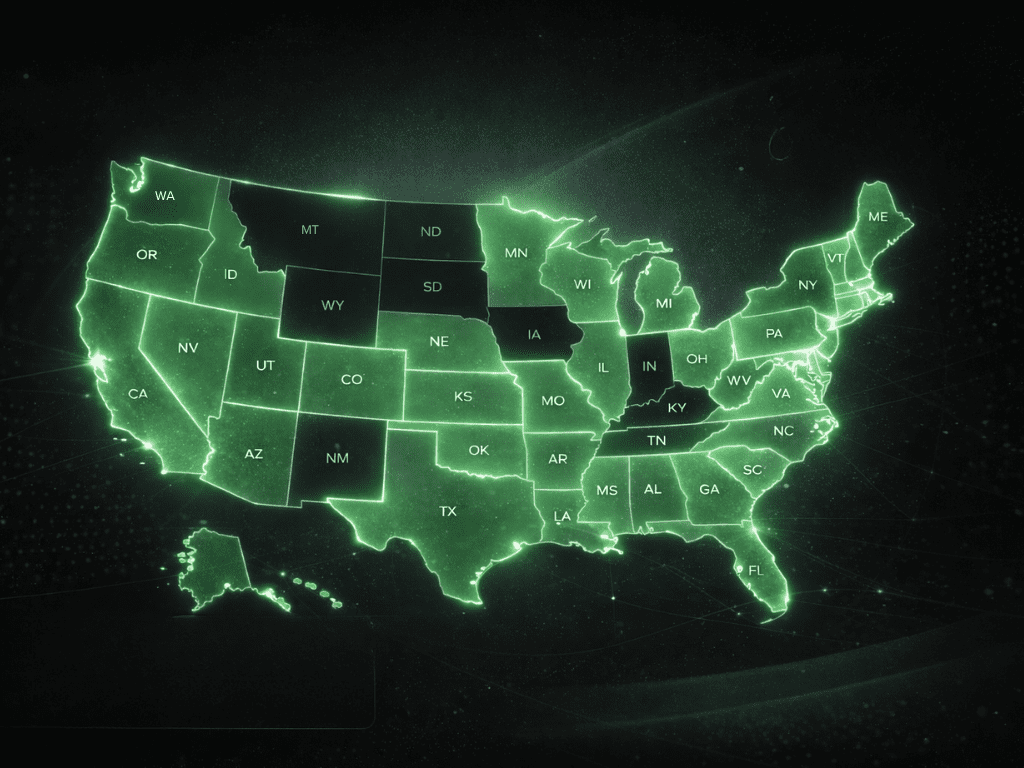
Understanding marijuana laws by state can feel overwhelming, and honestly, that’s because it is complicated. The United States has no single national cannabis policy. Instead, each state sets its own rules, creating a patchwork of laws where what’s perfectly legal on one side of a state line can be a criminal offense on the other.
Here’s where things stand as of early 2026:
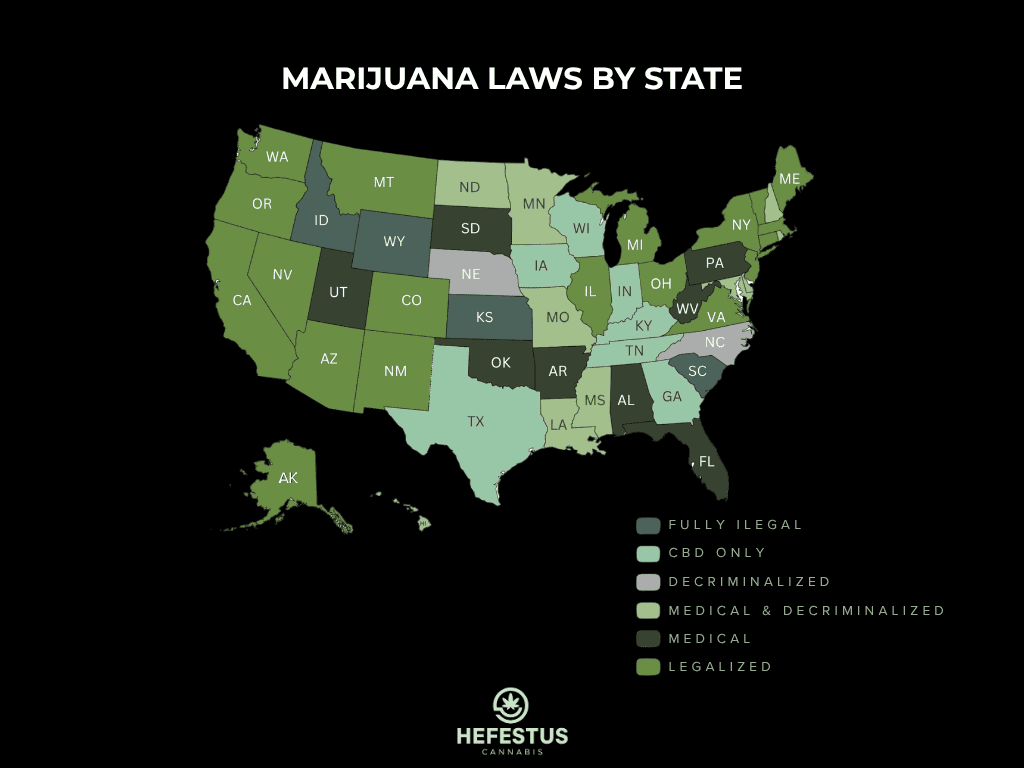
24 states plus Washington D.C. have legalized recreational marijuana for adults 21 and older. An additional 13 states allow medical use only. Eight states permit only low-THC/CBD products. Four states — Idaho, Indiana, Kansas, and Nebraska — still classify marijuana as fully illegal under state law, though Nebraska voters approved a medical program in November 2024 that is not yet operational.
Why Marijuana Laws Are So Complicated Right Now
If you’ve tried to figure out marijuana laws across the United States lately, you already know the problem: every source seems to say something slightly different. That’s not an accident — it’s a reflection of how fast the legal landscape is moving.
Since California became the first state to legalize medical cannabis in 1996, American marijuana law has undergone one of the most rapid legal transformations in modern history. What started as a fringe ballot initiative has become mainstream policy, with the majority of Americans now living in states where some form of cannabis use is legal.
But “legal” is doing a lot of heavy lifting in that sentence.
In some states, you can walk into a dispensary and buy flower, edibles, and concentrates like you’d buy wine from a liquor store. In others, a doctor can recommend cannabis but retail sales are banned. In a few, you can possess marijuana legally but have no legal way to obtain it. And in a handful of states, any amount can still land you in jail.
On top of that, federal law still classifies marijuana as a Schedule I controlled substance — the same category as heroin — although a December 2025 executive order from President Trump directed federal agencies to pursue reclassification to Schedule III, a change that is still working through the DEA rulemaking process as of early 2026.
This guide synthesizes data from nine authoritative sources — NORML, DISA, the Marijuana Policy Project, FindLaw, the National Conference of State Legislatures, USAFacts, MJBiz Factbook, the American Nonsmokers’ Rights Foundation, and Encyclopædia Britannica — to give you the most complete, accurate, and readable picture available anywhere.
The Big Picture: A National Snapshot
Here’s where things stand across the country as of early 2026:
| Category | Number of States |
| Fully legal (recreational + medical) | 24 states + DC |
| Medical marijuana only (full program) | ~13 states |
| CBD/Low-THC programs only | ~8 states |
| Fully illegal | 4 states (ID, IN, KS, NE*) |
*Nebraska voters approved medical marijuana in November 2024, but implementation is pending as of early 2026.
Some fast facts worth knowing:
- The legal cannabis industry was valued at approximately $33.6 billion in 2023 and is projected to exceed $76 billion by 2030 (MPP).
- In 2022 alone, the cannabis sector created more than 100,000 new jobs — a 33% increase from the year prior.
- 40 states plus DC and three territories now allow some form of medical cannabis access.
- As of 2023, 45 states plus two territories and DC have record-clearing laws that may apply to cannabis convictions (NCSL).
- Daily marijuana use among young adults was 11% in 2021, up from 6% a decade earlier.
For a deeper dive, explore our comprehensive Cannabis Industry Statistics — covering market size, revenue, employment, and investment data — or our dedicated Cannabis Use Statistics for UK if you’re looking at trends beyond American borders.
Marijuana Laws by State: Complete State-by-State Breakdown
The table below is the most comprehensive synthesis available, cross-referenced across nine sources. Medical year refers to when a comprehensive medical program was enacted (not CBD-only laws). Recreational year refers to when adult-use legislation passed (not necessarily when retail sales began).
| State | Recreational Legal? | Medical Legal? | Decriminalized? | Rec Year | Med Year | Notes |
| Alabama | No | Yes | No | — | 2021 | No dispensaries open as of Jan 2026; 3 licenses issued Jan 8, 2026 |
| Alaska | Yes | Yes | Yes | 2014 | 1998 | Retail sales began Oct 2016 |
| Arizona | Yes | Yes | Yes | 2020 | 2010 | Retail sales began Jan 22, 2021 |
| Arkansas | No | Yes | No | — | 2016 | No recreational use |
| California | Yes | Yes | Yes | 2016 | 1996 | First state to legalize medical; retail rec sales Jan 1, 2018 |
| Colorado | Yes | Yes | Yes | 2012 | 2000 | First state to open recreational dispensaries (Jan 1, 2014) |
| Connecticut | Yes | Yes | Yes | 2021 | 2012 | Retail sales began Jan 10, 2023 |
| Delaware | Yes | Yes | Yes | 2023 | 2011 | Law took effect without governor’s signature or veto |
| District of Columbia | Yes* | Yes | Yes | 2015 | 2011 | *Retail sales prohibited; possession/gifting legal for adults 21+ |
| Florida | No | Yes | No | — | 2016 | Ballot measure to legalize rec use failed Nov 2024 |
| Georgia | No | CBD Only | No | — | 2015 | Limited to 20 fl oz of cannabis product ≤5% THC; first dispensaries opened 2023 |
| Hawaii | No | Yes | Yes | — | 2000 | Possession decriminalized; no retail recreational |
| Idaho | No | No | No | — | — | One of only four fully illegal states |
| Illinois | Yes | Yes | Yes | 2019 | 2014 | Retail sales began Jan 1, 2020; up to 30g flower |
| Indiana | No | No | No | — | — | CBD oil ≤0.3% THC only via limited access |
| Iowa | No | CBD Only | No | — | 2014 | CBD oil limited; up to 4.5g THC per 90-day period |
| Kansas | No | No | No | — | — | CBD with no THC (2018); affirmative defense for ≤5% THC CBD (2019) |
| Kentucky | No | Yes | No | — | 2025 | Full medical program launched 2025; no smoking plant material |
| Louisiana | No | Yes | Yes | — | 2015 | Decriminalized possession; medical program operational |
| Maine | Yes | Yes | Yes | 2016 | 1999 | Retail sales began Oct 9, 2020 |
| Maryland | Yes | Yes | Yes | 2022 | 2014 | Retail sales began July 1, 2023 |
| Massachusetts | Yes | Yes | Yes | 2016 | 2013 | Retail sales began Nov 20, 2018 |
| Michigan | Yes | Yes | Yes | 2018 | 2008 | Retail sales began Dec 1, 2019 |
| Minnesota | Yes | Yes | Yes | 2023 | 2014 | Retail sales projected Q1 2025 |
| Mississippi | No | Yes | Yes | — | 2022 | Possession decriminalized; medical program launched 2022 |
| Missouri | Yes | Yes | Yes | 2022 | 2018 | Retail sales began Feb 6, 2023; automatic expungement required |
| Montana | Yes | Yes | Yes | 2020 | 2004 | Retail sales began Jan 1, 2022 |
| Nebraska | No | No* | Yes | — | 2024* | Voters approved medical in Nov 2024; implementation pending; listed as illegal by FindLaw |
| Nevada | Yes | Yes | Yes | 2016 | 2000 | Retail sales began July 1, 2017 |
| New Hampshire | No | Yes | Yes | — | 2013 | Decriminalized; medical only; no recreational |
| New Jersey | Yes | Yes | Yes | 2020 | 2010 | Retail sales began April 21, 2022 |
| New Mexico | Yes | Yes | Yes | 2021 | 2007 | Retail sales began April 1, 2022 |
| New York | Yes | Yes | Yes | 2021 | 2014 | Retail sales began Dec 29, 2022; up to 3 oz flower |
| North Carolina | No | CBD Only | Yes | — | 2014 | CBD ≤0.9% THC only; possession decriminalized |
| North Dakota | No | Yes | Yes | — | 2016 | Decriminalized; ballot measure for rec use failed Nov 2024 |
| Ohio | Yes | Yes | Yes | 2023 | 2016 | Retail sales began Aug 6, 2024; some cities have temporary bans on cannabis businesses |
| Oklahoma | No | Yes | No | — | 2018 | Medical only; among most permissive medical programs in U.S. |
| Oregon | Yes | Yes | Yes | 2014 | 1998 | Retail sales began Oct 1, 2015; most permissive possession limits |
| Pennsylvania | No | Yes | No | — | 2016 | Medical only; no recreational; 30-day supply limit |
| Rhode Island | Yes | Yes | Yes | 2022 | 2006 | Retail sales began Dec 1, 2022 |
| South Carolina | No | CBD Only | No | — | 2014 | CBD ≤0.9% THC only |
| South Dakota | No | Yes | No | — | 2021 | Ballot measure for rec use failed Nov 2024 |
| Tennessee | No | CBD Only | No | — | 2015 | CBD ≤0.9% THC; very limited medical use |
| Texas | No | CBD Only | No | — | 2015 | Expanded in 2025 to allow ≤10mg THC per dosage unit |
| Utah | No | Yes | No | — | 2018 | Medical only; up to 113g unprocessed cannabis |
| Vermont | Yes | Yes | Yes | 2018 | 2004 | First state to legalize via legislature (not ballot initiative); retail sales Oct 1, 2022 |
| Virginia | Yes* | Yes | Yes | 2021 | 2020 | *Possession/cultivation legal; retail sales bill vetoed by governor in 2024 |
| Washington | Yes | Yes | Yes | 2012 | 1998 | Co-first to legalize recreational; retail sales began July 8, 2014 |
| West Virginia | No | Yes | No | — | 2017 | Medical only; 30-day supply |
| Wisconsin | No | CBD Only | No | — | 2017 | CBD without psychoactive effect only |
| Wyoming | No | CBD Only | No | — | 2015 | CBD ≤0.3% THC only |
States with Recreational Dispensaries: Where Can You Buy?
Having recreational marijuana on the books and having a place to actually buy it are two different things — and this distinction trips up a lot of travelers and new residents.
Here are the 24 states plus DC where recreational use is legal, with notes on retail availability:
Fully operational retail markets: Alaska, Arizona, California, Colorado, Connecticut, Delaware, Illinois, Maine, Maryland, Massachusetts, Michigan, Minnesota, Missouri, Montana, Nevada, New Jersey, New Mexico, New York, Ohio, Oregon, Rhode Island, Vermont, Washington
Legal but with major retail caveats:
- District of Columbia: Recreational possession and gifting are legal, but retail sales remain prohibited due to Congressional interference with DC’s budget autonomy. You can receive cannabis as a “gift” with a purchase of another item — a legal gray area that has spawned a cottage industry.
- Virginia: Possession of up to 1 oz and home cultivation are legal since 2021, but retail sales legislation was vetoed by Governor Glenn Youngkin in 2024. As of early 2026, there is no legal retail pathway for recreational consumers despite the law being on the books.
- Ohio: Retail sales began August 6, 2024, but some cities and townships have enacted temporary bans on adult-use cannabis businesses within their jurisdictions.
Possession limits at recreational dispensaries vary significantly. Oregon is among the most generous, allowing adults to possess up to 8 ounces of usable cannabis flower. New York allows up to 3 ounces on your person and 5 pounds in a private residence. Colorado and California cap recreational possession at 1–2 ounces outside the home.
Pro tip for travelers: Being in a state where recreational marijuana is legal doesn’t mean you can take it with you when you leave. Transporting cannabis across state lines — even between two legal states — remains a federal crime because it involves interstate commerce.
Medical-Only States: Access Without Adult-Use Rights
Thirteen states have comprehensive medical marijuana programs but have not yet extended legalization to recreational adult use. These states allow licensed physicians to recommend cannabis for qualifying medical conditions, which typically include chronic pain, cancer, epilepsy, PTSD, multiple sclerosis, and others — though the specific qualifying conditions vary by state.
The medical-only states as of early 2026:
Alabama — The program was signed into law in 2021, but implementation has moved slowly. As of January 2026, three dispensary licenses were issued on January 8, 2026, with a fourth under consideration — meaning patients have had virtually no retail access despite the law being nearly five years old.
Arkansas — Medical marijuana has been operational since 2016, allowing up to 2.5 ounces. No recreational pathway exists.
Florida — Voters expanded full medical access in 2016. A November 2024 ballot measure to legalize recreational use failed to reach the required 60% supermajority threshold. Medical patients can possess a 70-day supply or up to 4 ounces for smoking.
Hawaii — Medical since 2000; possession decriminalized. Legislative efforts to add recreational use have not yet succeeded.
Kentucky — One of the most recent additions to the medical-only category: a full medical cannabis program launched in January 2025. Patients can access regulated products, but smoking plant material remains prohibited.
Louisiana — Medical since 2015 (first dispensary opened 2019); possession decriminalized. Allows up to a one-month supply.
Mississippi — Medical program launched in 2022 following a complicated ballot initiative process. Possession also decriminalized.
New Hampshire — Medical since 2013; possession decriminalized. A recreational legalization bill passed the state House in 2024 but has not yet been signed into law.
North Dakota — Medical since 2016; possession decriminalized. A ballot measure to legalize recreational use failed in November 2024.
Oklahoma — Medical since 2018 with one of the most permissive programs in the country: patients can possess up to 72 ounces of edibles, 3 ounces on their person, 8 ounces at home, and 1 ounce of concentrate. No recreational program.
Pennsylvania — Medical since 2016; 30-day supply limits. Recreational legalization has been debated in the legislature but has not passed.
South Dakota — Medical since 2021. A ballot measure for recreational use failed in November 2024 — the second time such a measure has been rejected (the first passed in 2020 but was overturned by the state Supreme Court).
West Virginia — Medical since 2017; 30-day supply limit. No recreational program.
CBD and Low-THC States: The Gray Zone
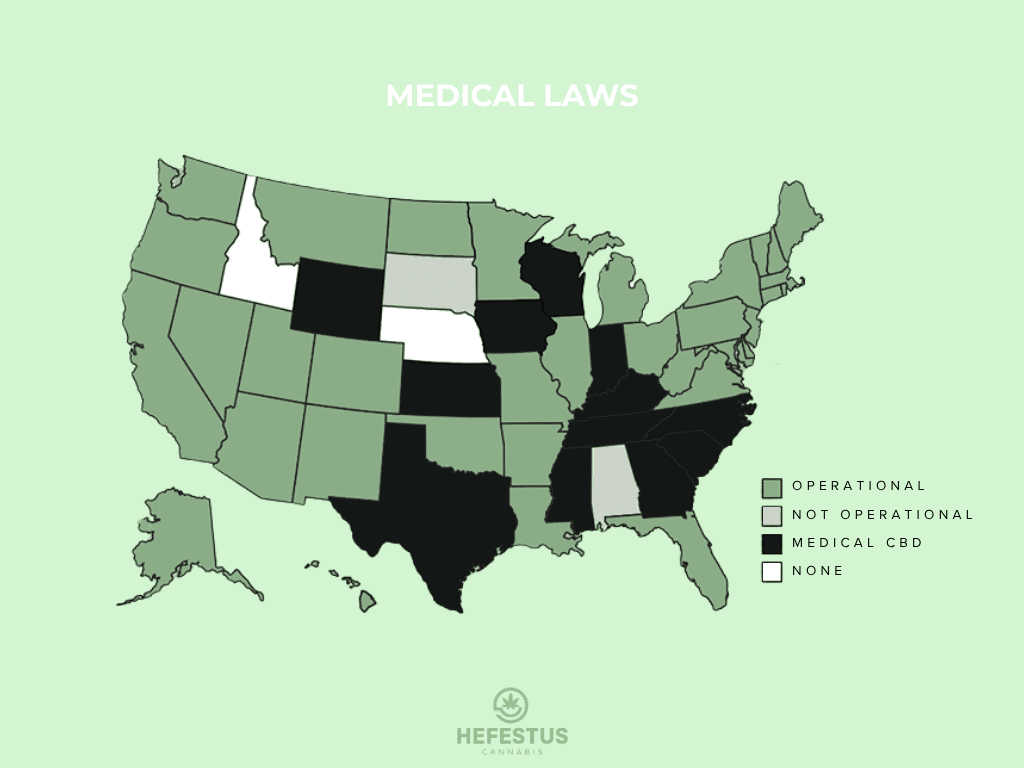
Eight states occupy a difficult middle ground: they technically have “medical marijuana” laws on the books, but those laws are so restrictive they don’t qualify as comprehensive medical programs under most accepted definitions.
These states typically allow only CBD (cannabidiol) oil products with very low — or zero — THC content. Since CBD is non-psychoactive, these products don’t produce the effects most people associate with marijuana. They may help certain conditions (particularly pediatric epilepsy), but they leave most patients without access to the full range of cannabis therapeutics.
The eight states in this category, and what they actually allow:
Georgia — Patients may possess up to 20 fluid ounces of cannabis products containing no more than 5% THC. First licensed dispensaries opened in 2023 following a 2015 law and subsequent expansions.
Indiana — CBD oil with no more than 0.3% THC. Not considered a medical marijuana program by NORML or the MPP.
Iowa — CBD oil with up to 4.5 grams of THC purchasable per 90-day period. Updated from a 3% THC limit in 2020.
Kansas — Pure CBD oil with no THC was legalized in 2018. A 2019 law added an affirmative legal defense for patients using physician-ordered CBD with up to 5% THC — but this is a defense, not a right.
North Carolina — CBD products with no more than 0.9% THC, effective 2014. Possession is decriminalized, but no comprehensive medical or recreational program exists.
South Carolina — Similar to North Carolina: CBD oil with ≤0.9% THC, effective 2014. No decriminalization.
Tennessee — CBD oil with ≤0.9% THC for specific conditions. One of the most restricted access regimes in the country.
Wyoming — CBD oil with ≤0.3% THC, effective 2015. No comprehensive medical program.
Texas occupies a special sub-category: technically a limited medical program (not pure CBD-only), it was expanded in 2025 to allow products with up to 10 milligrams of THC per dosage unit — still very restrictive but a meaningful step forward for the state.
Fully Illegal States: Where Marijuana Remains Criminalized
As of early 2026, four states maintain full prohibition of marijuana in all forms:
Idaho — The most consistently restrictive state in the nation. No medical program, no CBD allowance (with THC), no decriminalization. Idaho’s geography — surrounded by legal states Oregon, Nevada, and Washington — has made it a subject of ongoing political debate. House Bill 370 was introduced to explore medical access, but has not advanced.
Indiana — No medical or recreational program despite being surrounded by legal states Illinois and Michigan. Some CBD oil access exists, but with no formal medical framework. Legislative efforts have stalled repeatedly.
Kansas — Arguably the most complex “illegal” state: technically classified as illegal because the 2018 law allows only CBD with zero THC, and the 2019 affirmative defense provision is not a legalization pathway. House Bill 2184 proposed medical cannabis legalization but has not passed.
Nebraska — The most fluid situation of the four. Voters approved a medical marijuana ballot initiative in November 2024, but as of early 2026, the law has not been implemented — no dispensaries, no patient registry, no operational program. FindLaw still lists Nebraska as fully illegal. The Nebraska Medical Cannabis Commission issued its first licenses in early 2026.
Important note for travelers: If you’re crossing from a legal state into any of these four states, possessing marijuana — even legally purchased out-of-state — is a criminal offense. Idaho, in particular, has aggressively prosecuted interstate marijuana cases given its proximity to three legal states.
Possession Limits by State: How Much Can You Legally Carry?
One of the most practically important — and least consistently reported — aspects of marijuana law is how much you can legally possess. Here are the recreational possession limits for adults in fully legal states:
| State | On Person (Flower) | At Home | Notes |
| Alaska | 1 oz | — | |
| Arizona | 1 oz (max 5g concentrate) | — | |
| California | 28.5g (~1 oz) | — | Max 8g concentrate |
| Colorado | 2 oz | — | |
| Connecticut | 1.5 oz | 5 oz | In locked storage at home or in car |
| Delaware | 1 oz | — | 12g concentrate; 750mg THC in products |
| Illinois | 30g | — | 500mg THC infused; 5g concentrate |
| Maine | 2.5 oz | — | |
| Maryland | 1.5 oz | — | 12g concentrate; 750mg THC in products |
| Massachusetts | 1 oz | 10 oz | |
| Michigan | 2.5 oz | 10 oz | |
| Minnesota | 2 oz | — | 8g concentrate; 800mg edibles |
| Missouri | 3 oz | More if registered cultivator | |
| Montana | 1 oz | — | Max 8g concentrate; 800mg edible THC |
| Nevada | 1 oz | — | |
| New Jersey | 1 oz | — | |
| New Mexico | 2 oz | — | 16g extract; 800mg edibles |
| New York | 3 oz | 5 lbs | 24g concentrate |
| Ohio | 2.5 oz | — | Max 15g adult extract |
| Oregon | 8 oz usable | — | Also 16 oz solid cannabinoid; 72 oz liquid; 16 oz concentrate |
| Rhode Island | 1 oz | 10 oz | |
| Vermont | 1 oz | — | |
| Virginia | 1 oz | — | Possession/cultivation only; no retail |
| Washington | 1 oz usable | — | 16 oz solid infused; 72 oz liquid; 7g concentrate |
Oregon stands out as the most permissive state by possession limits — adults can legally possess up to 8 ounces of cannabis flower, more than seven times the limit in states like Alaska or Nevada.
New York’s home possession limit — 5 pounds — is striking and reflects the state’s emphasis on allowing home cultivation alongside retail access.
The Federal Picture: Schedule I, Schedule III, and What’s Changing
Despite sweeping state-level change, marijuana has remained a Schedule I controlled substance under the federal Controlled Substances Act (CSA) of 1970 for more than five decades. Schedule I classification means the federal government officially considers marijuana to have a high potential for abuse, no accepted medical use, and no accepted safe use under medical supervision — a position that increasingly conflicts with scientific consensus and the laws of 24 states.
The December 2025 executive order signed by President Trump directed the Drug Enforcement Administration (DEA) and the Department of Health and Human Services (HHS) to pursue reclassification of marijuana to Schedule III. Schedule III drugs — which include ketamine and anabolic steroids — are considered to have moderate to low potential for dependence and accepted medical use.
This is a significant development, but it’s important to understand what it does and doesn’t mean:
- It does not immediately change federal law
- It does not make marijuana federally legal
- It does not override state prohibition laws
- It would reduce federal penalties for possession
- It would allow cannabis to be studied in formal clinical trials
- It would allow cannabis businesses to deduct ordinary business expenses on federal taxes (a major financial burden under current law)
- It would ease banking restrictions for cannabis companies
The rulemaking process is ongoing as of early 2026 and could take months or years to finalize. Congress could also act directly — the MORE Act, which would remove marijuana from the CSA entirely, passed the House in April 2022 but stalled in the Senate.
The practical federal conflict: Even in the most cannabis-friendly states, marijuana businesses operate in a legally fraught environment. They cannot use federally regulated banks (most major banks won’t work with cannabis companies), cannot deduct business expenses on federal income taxes, and cannot use federally managed water resources for cultivation. Federal employees and military personnel remain prohibited from using marijuana regardless of state law.
Decriminalization vs. Legalization: Understanding the Difference
These two terms are often used interchangeably, but they mean very different things in practice.
Legalization means the state has affirmatively created a legal framework for marijuana use, possession, and in most cases sale. Adults have a legal right to possess up to the specified amount. There are licensed dispensaries. The state regulates and taxes the product.
Decriminalization means small amounts of marijuana are no longer treated as criminal offenses — you won’t go to jail for possession of a personal-use amount — but marijuana is still technically illegal. You may receive a civil citation or fine (similar to a parking ticket), but not a criminal record. There are no legal dispensaries in decriminalization-only states.
States that have decriminalized but not legalized as of early 2026 include: Hawaii, Louisiana, Mississippi, Nebraska, New Hampshire, North Carolina, and North Dakota — the states specifically cited in NCSL’s decriminalization framework.
Why this matters: In a decriminalized state, you can still be cited, fined, and have your marijuana confiscated even if you won’t face criminal prosecution. You still have no legal way to obtain marijuana. And federal law still applies — federal employees, contractors, and anyone crossing state lines can still face federal consequences.
Record Expungement: Cleaning the Slate
One of the most consequential — and underreported — aspects of marijuana legalization is what happens to the people who were already convicted under laws that have since changed.
As of 2023, 45 states plus two territories and Washington D.C. have some form of record-clearing laws that may apply to cannabis convictions (NCSL). Of these, 28 have legislation specifically targeting cannabis offense record clearance. Eleven states, D.C., and the U.S. Virgin Islands have enacted automatic expungement — meaning eligible records are cleared without requiring individuals to petition the court.
The American Medical Association, which still opposes cannabis legalization, has nonetheless endorsed record expungement for certain cannabis-related offenses. AMA Trustee Scott Ferguson, M.D., stated that conviction records for now-legal activities unfairly block young people from “careers in medicine as well as many others who are denied housing, education, loans and job opportunities.”
Automatic expungement states include: California, Colorado, Illinois, Maryland, Massachusetts, Michigan, Missouri, New Jersey, New York, Oregon, and Washington.
Missouri’s story is instructive: After voters amended the state constitution in 2022 to require automatic expungement for eligible cannabis convictions, courts were required to clear records by end of 2023 — but the process has been significantly slowed by non-digitized criminal records and the need to hire additional staff to process the volume of cases.
California’s approach has been different: prosecutors were given the opportunity to challenge cases before they were automatically sealed, with records cleared if no opposition was filed within one year.
Governors in Colorado, Illinois, Maryland, Massachusetts, Oregon, and Pennsylvania have also issued pardons for low-level marijuana convictions, and Nevada’s governor proposed an amended resolution in 2020 that was unanimously approved by the State Board of Pardons Commissioners.
How Marijuana Laws Have Changed: A Timeline
What to Expect Next: States on the Verge of Change
Several states are actively debating or have pending legislation that could shift their legal status in 2026 or 2027:
Pennsylvania — Recreational legalization has been a perennial legislative debate. With neighboring New Jersey, New York, Maryland, and Ohio all having legal recreational markets, economic pressure to act is intensifying. Governor Josh Shapiro has expressed support for legalization.
New Hampshire — The state House has passed recreational legalization bills; the Senate has been the obstacle. New Hampshire is the only New England state without recreational access, which has become a significant political issue given that every state surrounding it has a legal market.
Nebraska — The 2024 ballot initiative medical program is working through implementation. Dispensary licensing is underway as of early 2026.
Virginia — Governor Youngkin’s veto of retail sales legislation in 2024 means the state is in an unusual position: recreational possession and cultivation are legal, but there is no retail market. The next gubernatorial election could be pivotal.
Federal rescheduling — The DEA rulemaking process for Schedule III reclassification could conclude in 2026, which would be the most significant federal cannabis policy change since 1970. This would not legalize marijuana federally but would meaningfully change penalties, research access, and business regulations.
FAQs: Marijuana Laws by State
Is marijuana legal federally in the United States?
No. Marijuana remains a Schedule I controlled substance under the federal Controlled Substances Act of 1970. A December 2025 executive order directed reclassification to Schedule III, but this change requires DEA rulemaking and had not taken legal effect as of early 2026.
Can I travel between two legal states with marijuana?
No. Transporting marijuana across state lines — even between two fully legal states — is a federal crime. This includes driving, flying, taking a train, or shipping.
What states have recreational dispensaries open?
As of early 2026: Alaska, Arizona, California, Colorado, Connecticut, Delaware, Illinois, Maine, Maryland, Massachusetts, Michigan, Minnesota, Missouri, Montana, Nevada, New Jersey, New Mexico, New York, Ohio, Oregon, Rhode Island, Vermont, and Washington all have operational adult-use retail markets. Virginia and DC do not have retail sales despite having recreational legalization on the books.
What is the difference between decriminalization and legalization?
Decriminalization removes criminal penalties for small amounts of marijuana but does not create a legal market. Legalization affirmatively permits use, possession, and typically sale through licensed dispensaries.
Which states are fully illegal for marijuana?
As of early 2026: Idaho, Indiana, Kansas, and Nebraska have no operational marijuana programs. Nebraska voters approved medical marijuana in November 2024 but implementation is pending.
Can I use a medical marijuana card from my home state in another state?
Some states have reciprocity programs that honor out-of-state medical cards — but this is not universal. States that have offered some form of reciprocity include Arizona, Arkansas, Maine, Michigan, Missouri, Nevada, Oklahoma, and Washington DC, though policies change frequently and should be verified before travel.
How old do I have to be to purchase marijuana legally?
In all states with recreational programs, the minimum age is 21. For medical programs, most states allow patients of any age with physician recommendation, though minors often require parental consent and caregiver-assisted use.
Which state has the most permissive possession limits?
Oregon allows recreational possession of up to 8 ounces of usable cannabis flower. New York allows up to 5 pounds within a private residence. For on-person recreational possession, New York (3 oz), Missouri (3 oz), and Illinois (30 grams of flower) are among the most generous.
A Note on Sources and Accuracy
Cannabis law changes more rapidly than almost any other area of American jurisprudence. This guide synthesizes data from nine authoritative sources including NORML, DISA, the Marijuana Policy Project (MPP), FindLaw (legally reviewed January 21, 2026), the National Conference of State Legislatures (NCSL), USAFacts, MJBiz Factbook, the American Nonsmokers’ Rights Foundation (ANRF), and Encyclopædia Britannica, reflecting the most current information available as of early 2026.
Where sources disagreed — and they do, particularly on Nebraska, Virginia, and CBD-only states — we have noted the discrepancy and explained the underlying reason. Laws that are on the books but not yet operational, programs that have passed but not yet been implemented, and rules that technically exist but are practically unenforceable all create genuine ambiguity that any responsible source must acknowledge.
For any legal decisions about marijuana use, possession, or business operations, consult a licensed attorney in your jurisdiction. This guide is for informational purposes only and does not constitute legal advice.
Sources: NORML | DISA | Marijuana Policy Project | FindLaw | NCSL | USAFacts | MJBiz | American Nonsmokers’ Rights Foundation| Britannica