Alaska Cannabis Laws
Alaska isn’t just one of the most breathtaking states in America – it’s also one of the most progressive when it comes to cannabis legislation. Long before most of the country was even debating legalization, Alaska’s Supreme Court ruled in 1975 that personal marijuana use in the home was a protected constitutional right. Half a century later, the state has built a fully regulated recreational and medical marijuana market that serves both residents and millions of visitors annually.
But “legal” doesn’t mean “anything goes.” Whether you’re a tourist exploring Fairbanks under the Northern Lights, a prospective dispensary owner, a medical patient, or simply an Alaskan curious about your rights, understanding exactly where the law stands is critical. Get it wrong, and you could face fines, criminal charges, or worse.
This guide pulls together everything you need to know about Alaska cannabis laws in one place – from possession limits and penalty charts to retail regulations, medical marijuana, and safe consumption tips.
A Brief History of Cannabis Laws in Alaska
Understanding Alaska’s cannabis laws today requires knowing how they evolved – because this state has a uniquely complicated legislative history.
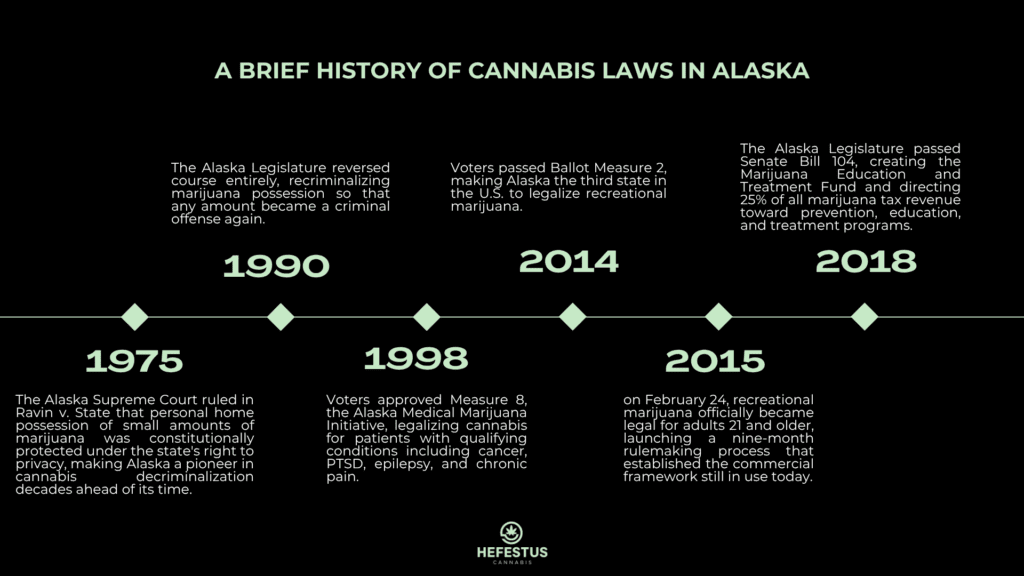
1975 – The Alaska Supreme Court ruled in Ravin v. State that possession of small amounts of marijuana for personal use in a private residence was protected under the state constitution’s right to privacy. Alaska became a pioneer in cannabis decriminalization decades ahead of its time.
1990 – The Alaska Legislature reversed course, recriminalizing marijuana possession entirely. Any amount became a criminal offense again.
1998 – Voters approved Measure 8, the Alaska Medical Marijuana Initiative, legalizing cannabis for patients with qualifying conditions such as cancer, PTSD, epilepsy, and chronic pain.
2014 – Voters passed Ballot Measure 2, making Alaska the third state in the U.S. to legalize recreational marijuana.
February 24, 2015 – Recreational marijuana officially became legal for adults 21 and older. A nine-month rulemaking process followed, establishing the commercial framework still in use today.
2018 – The Alaska Legislature passed Senate Bill 104, creating the Marijuana Education and Treatment Fund, directing 25% of all marijuana tax revenue toward prevention, education, and treatment programs.
Is Cannabis Legal in Alaska? The Short Answer
Yes – recreational cannabis is fully legal in Alaska for adults 21 and older. Medical marijuana has been legal since 1998. However, the legality is bound by strict rules about quantity, location, and commercial activity. Breaking those rules carries real consequences.
The Alcohol and Marijuana Control Office (AMCO), operating under both the Alcoholic Beverage Control (ABC) Board and the Marijuana Control Board (MCB), serves as the primary regulatory body overseeing all cannabis activity in the state.
Personal Possession: What You Can Legally Have
Under Alaska Statute § 17.38.020, adults 21 and older may legally possess:
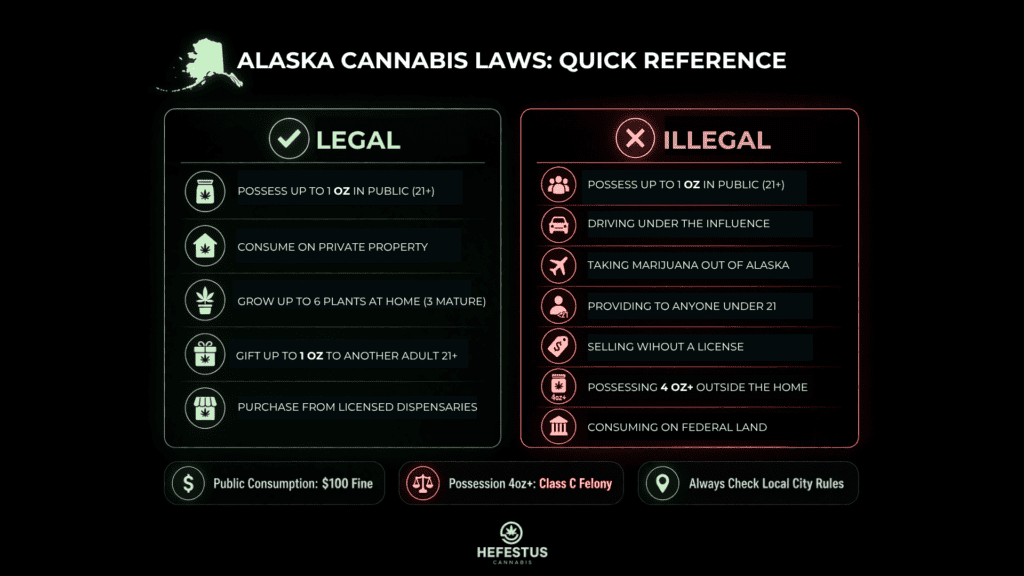
- Up to 1 ounce (approximately 28 grams) of usable marijuana in public or outside their residence
- More than 1 ounce of marijuana at home, if it was grown there – home-grown yield stored where it was produced is not subject to the 1-ounce limit
- Marijuana concentrates, edibles, tinctures, oils, waxes, and hashes – all legal for adult possession
Possession in your private home receives additional protection under Alaska’s constitutional right to privacy. Possession of 1 to less than 4 ounces in a private residence for personal use carries no penalty.
Possession Penalties at a Glance
| Amount | Location | Classification | Penalty |
| 1 oz or less | Anywhere | None | No penalty |
| 1–4 oz | Private residence | Protected by privacy right | No penalty |
| 1–4 oz | Outside home | Class A Misdemeanor | Up to 1 year / $10,000 fine |
| 4 oz or more | Anywhere | Class C Felony | Up to 5 years / $50,000 fine |
| Any amount | Within 500 ft of school or rec center | Class C Felony | Up to 5 years / $50,000 fine |
| Public consumption | Public space | Violation | $100 fine |
One important nuance: the school zone felony has an affirmative defense if the conduct occurred entirely within a private residence.
Home Cultivation: Growing Your Own Cannabis in Alaska
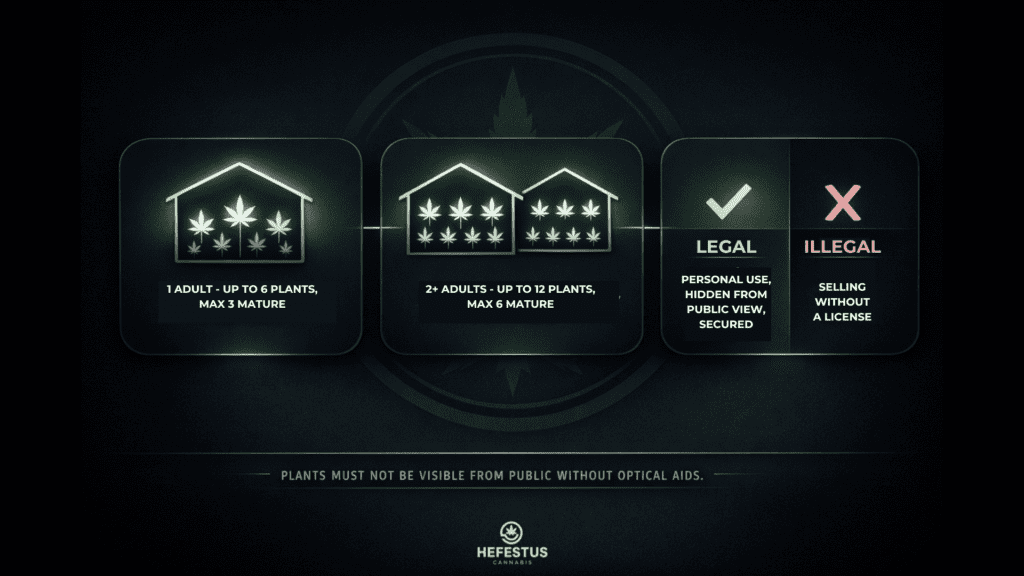
One of Alaska’s most permissive cannabis policies involves home growing. Adults 21 and older may cultivate marijuana plants at home without any license or permit, provided they follow these rules:
- Up to 6 plants per adult, with no more than 3 mature, flowering plants at any one time
- Up to 12 plants total (no more than 6 mature) if two or more adults share a residence
- Plants must be out of public view – not visible without the use of binoculars, aircraft, or other optical aids
- Plants must be secured from unauthorized access
- You cannot sell any marijuana you grow, even if you stay under the legal plant count
Cultivation of fewer than 25 plants for personal use in a private home is protected under Alaska’s right-to-privacy provisions. Growing 25 or more plants becomes a Class C felony, punishable by up to 5 years imprisonment and a $50,000 fine.
Where Can You Consume Cannabis in Alaska?
This is where many visitors and even residents get tripped up. Legal possession does not mean legal consumption anywhere.
Legal Consumption Locations
- Private residences – the most straightforward legal option
- Private property with the owner’s explicit permission
- Licensed onsite consumption areas at approved retail dispensaries (subject to board approval and strict regulations)
Illegal Consumption Locations
- All public spaces: streets, sidewalks, parks, playgrounds
- Schools, amusement venues, businesses open to the public
- Federal land: national parks, national forests – marijuana remains a Schedule I controlled substance under federal law
- Hotels and rental properties – unless the owner explicitly permits it (always verify before assuming)
- Vehicles: You cannot consume marijuana in or while operating any motorized vehicle – cars, snowmobiles, boats, ATVs, or aircraft
Violating public consumption laws results in a $100 fine, but other violations (like consuming near a school) carry far steeper consequences.
Cannabis and Driving: A DUI Is a DUI
Driving under the influence of marijuana is treated the same as driving drunk in Alaska. Under AS 28.35.030, you can be charged with a DUI while operating a car, aircraft, or watercraft – motorized or not. If you’re unsure whether you’re impaired, don’t drive. There are no safe shortcuts here.
Retail Cannabis Laws in Alaska
Recreational marijuana sales are conducted exclusively through state-licensed retail stores regulated by the Marijuana Control Board. Key rules include:
Purchase Limits (Per Person, Per Day)
- 1 ounce of usable marijuana flower
- 7 grams of marijuana concentrate for inhalation
- 5,600 milligrams of THC in combined sales of marijuana and marijuana products
Store Operating Rules
- No sales between 5:00 a.m. and 8:00 a.m.
- No sales to anyone under 21 or to anyone visibly intoxicated
- No free samples or giveaways of marijuana products
- Customers must be physically present on the licensed premises – delivery is not currently permitted in Alaska
- Products cannot be sold past their labeled expiration date
- Alaska uses Metrc as its statewide track-and-trace system
Required In-Store Notices
Every licensed dispensary must display 11″ × 14″ signs (minimum ½” lettering) stating:
- Public consumption of marijuana is prohibited by law
- Transportation via Alaska waterways or air carriers is prohibited by federal law
- Transporting marijuana outside Alaska is prohibited by federal law
- Providing marijuana to anyone under 21 is prohibited by law
Packaging and Labeling Requirements
All products sold must be in opaque, resealable, child-resistant packaging and labeled with:
- The dispensary’s name/logo and license number
- Estimated total THC content
- Five mandatory warning statements covering impairment, health risks, age restrictions, and pregnancy
Onsite Consumption Endorsements
With board approval, licensed retail stores may operate a designated consumption area. Onsite purchase limits are much lower – just 1 gram of flower, 25mg THC in edibles, or 0.3 grams of concentrate via vaping per person per day. Consumption areas must be walled off, ventilated, monitored by staff, and free of tobacco. Employees cannot consume during work shifts.
Cannabis Taxes in Alaska
Alaska’s cannabis taxes are levied at the cultivation level, not at the point of retail sale. Tax rates (effective January 1, 2019) are:
| Product Type | Tax Rate |
| Mature bud/flower | $50 per ounce |
| Immature/abnormal bud | $25 per ounce |
| Trim | $15 per ounce |
| Clones | $1 per clone (flat rate) |
Alaska has no statewide retail excise tax, but municipalities can – and do – add their own. Anchorage imposes a 5% sales tax on retail marijuana purchases.
It’s worth noting that medical marijuana is tax-exempt, which is one of the practical advantages of obtaining a medical marijuana card for patients who qualify.
Medical Marijuana in Alaska
Alaska’s medical marijuana program, established in 1998, runs separately from the recreational market. Key differences include:
| Feature | Medical | Recreational |
| Minimum age | 18 (caregiver can supply to under-18) | 21 |
| Tax | Exempt | 20% effective |
| Plant limit | Up to 6 plants | Up to 6 plants |
| Card required | Yes (annual renewal) | No |
| Qualifying conditions | PTSD, cancer, epilepsy, chronic pain, others | N/A |
How to Get a Medical Marijuana Card in Alaska
- Receive a referral from a licensed medical professional
- Apply through the Alaska Department of Health’s Bureau of Vital Statistics
- Submit the Medical Marijuana Application Packet
- Pay applicable fees
Cards are valid for one year and must be renewed annually. Missing steps in the application can result in denial and a 6-month wait before reapplying. For questions, contact the Bureau of Vital Statistics at (907) 465-5423.
The card is only valid in Alaska and only available to Alaska residents.
Hashish and Cannabis Concentrates: Stricter Rules Apply
While flower and most marijuana products follow the standard possession rules, hashish and hashish oil are classified separately as Schedule IIIA substances in Alaska, making the penalties notably harsher:
- Possession of any amount: Misdemeanor – up to 1 year imprisonment and a $25,000 fine
- Possession within 500 feet of a school or rec center: Felony – up to 5 years, $50,000 fine
- Delivery, manufacture, or possession with intent to distribute: Felony – up to 10 years, $100,000 fine
This is a critical distinction many consumers overlook. Even small amounts of hash or hash oil carry misdemeanor charges.
Traveling With Cannabis: What You Absolutely Cannot Do
Cannabis may be legal in Alaska, but it stays in Alaska. Federal transportation laws make it illegal to take marijuana across state lines or international borders by any means:
- Airplanes – prohibited by federal law (TSA and FAA regulations apply)
- Ships and cruise ships – prohibited on Alaska waterways
- Trains – prohibited by federal law
Retail dispensaries are required to post these notices. Taking marijuana out of Alaska – even to another state where it’s legal – is a federal offense. Don’t do it.
Working in the Cannabis Industry: Marijuana Handler Permits
Anyone working at a licensed marijuana establishment – including dispensary staff (“budtenders”) – must hold a Marijuana Handler Permit issued by AMCO. Requirements include:
- Be at least 21 years old
- Complete a Marijuana Handler Permit Education course
- Pass a background check
- Submit an application and fees to AMCO
AMCO is currently managing operations primarily via email and dropbox submission, with in-person services closed on Wednesdays to address processing backlogs.
Safe Cannabis Use: What Alaska’s Health Department Wants You to Know
The Alaska Department of Health emphasizes responsible use alongside legalization. With an estimated 61.9 million marijuana users in the U.S. in 2022, and regular use linked to cannabis use disorder – particularly in those who start young – the state invests significantly in education and treatment.
Safe Use Guidelines
- Start with small doses, especially with edibles – effects can take up to 4 hours to fully manifest
- Only consume products where you know the THC content
- Never drive or operate machinery after consuming
- Pregnant or breastfeeding individuals should avoid cannabis entirely (see CDC guidance)
- Overuse can cause extreme confusion, anxiety, rapid heart rate, and severe nausea
Safe Storage
- Store all cannabis products in child-resistant, locked containers
- Keep products clearly labeled and out of reach of children, teens, and pets
- If a child accidentally ingests marijuana, call Poison Control at 1-800-222-1222 immediately or dial 9-1-1 for serious symptoms
Getting Help
Signs of cannabis use disorder include daily use lasting more than 1–2 hours, inability to stop, neglecting responsibilities, and impaired memory. Treatment resources are available at findtreatment.gov.
The state’s Marijuana Education and Treatment Fund (receiving 25% of marijuana tax revenue) supports afterschool programs, behavioral health resources for at-risk students, and partnerships with the Alaska Division of Juvenile Justice.
Cannabis Laws in Fairbanks: A Local Note for Visitors
Fairbanks serves as a key entry point for Alaska tourism, and cannabis tourism is part of the landscape. Licensed dispensaries operate within the Fairbanks North Star Borough and the City of Fairbanks, but notably not in the City of North Pole.
As with all Alaska communities, local governments may pass ordinances stricter than state law. Always verify local rules before purchasing or consuming in any new city or borough.
CBD in Alaska: Federally Legal, State-Regulated
Following the 2018 Farm Bill, hemp-derived CBD is federally legal, and Alaska permits its sale and possession provided:
- Products contain no more than 0.3% THC
- Packaging and labeling comply with standards set by the Alaska Department of Law and the Department of Natural Resources
Key Takeaways: Alaska Cannabis Laws at a Glance
- Legal for adults 21+ since February 24, 2015
- Possession limit: 1 oz in public; home-grown yield protected at home
- Home growing: Up to 6 plants (3 mature) per adult; 12 (6 mature) for 2+ adults in a household
- Public consumption: Strictly prohibited – private spaces only
- Driving high: DUI, same as alcohol
- Retail purchase limits: 1 oz flower, 7g concentrate, or 5,600mg THC per day
- Hashish/hash oil: Treated more harshly – misdemeanor even for small amounts
- Out of state: Never legal to transport
- Medical marijuana: Available to qualifying patients 18+ through annual registration
- Taxes: Levied at cultivation level; Anchorage adds 5% local sales tax
Understanding Alaska cannabis laws isn’t just about staying out of trouble – it’s about engaging responsibly with one of the most nuanced cannabis frameworks in the country. Whether you’re a resident, visitor, patient, or industry professional, knowing the rules protects you and supports the broader public health goals the state has worked hard to establish. Found this guide useful? Share it with anyone planning a trip to Alaska or navigating the state’s cannabis landscape. For more resources on cannabis regulations, compliance, and technology solutions, explore Hefestus.
Sources
- STATE OF ALASKA – OFFICE OF THE GOVERNOR – Personal Use and Possession of Marijuana
- NORML – Alaska Laws and Penalties
- 360TRAINING – Navigating Alaska’s Marijuana Laws
- FLOWHUB – 7 Alaska Cannabis Laws You Must Know
- EXPLORE FAIRBANKS ALASKA – Marijuana in Fairbanks
- STATE OF ALASKA – DEPARTMENT OF HEALTH – Marijuana – Get the facts about marijuana