Cannabis Use Statistics UK

Cannabis remains the most widely used controlled drug in the UK, with consistent levels of use across different age groups and regions. Over the past two decades, usage has moved from higher peak levels to a more stable and predictable pattern, reflecting a mature and established market.
Recent data shows that millions of adults continue to engage with cannabis each year, while a much larger share of the population reports lifetime exposure. At the same time, usage patterns vary significantly by age, income and frequency, with younger adults and repeat users playing a central role in overall demand.
Survey-based research also suggests that actual usage may be higher than official estimates, indicating a broader level of participation than commonly reported. Alongside this, the legal medical cannabis sector is expanding, adding a new layer to an already active market.
This article brings together the most reliable cannabis use statistics in the UK, providing a clear, data-driven view of market size, trends, user behaviour and long-term growth signals.
1. UK Cannabis Market Size and User Base
Cannabis usage in the UK represents a large and well-established consumer base across multiple demographics. Current data shows consistent participation levels, supported by both official statistics and survey-based research.
- 6.8% of adults aged 16 to 59 used cannabis in the past year in 2024, equal to around 2.3 million people (Releaf).
- 7.6% of adults aged 16 to 59 (around 2.5 million people), used cannabis in 2023 (ONC).
- 6.5% of adults aged 16 to 59, used cannabis in the year ending March 2025 (ONC).
- 30% of adults aged 16 to 64 (around 10 million) In England and Wales, have tried cannabis at least once (National Statistics).
- 23.78% of respondents in one UK survey reported lifetime cannabis use (Releaf).
- 45.1% of consumers are lifetime users, 9.1% past-year use and 4.7% past-month use (Taylor & Francis).
- Cannabis remains the most frequently used drug in England and Wales at 6.473% (Russell Webster).
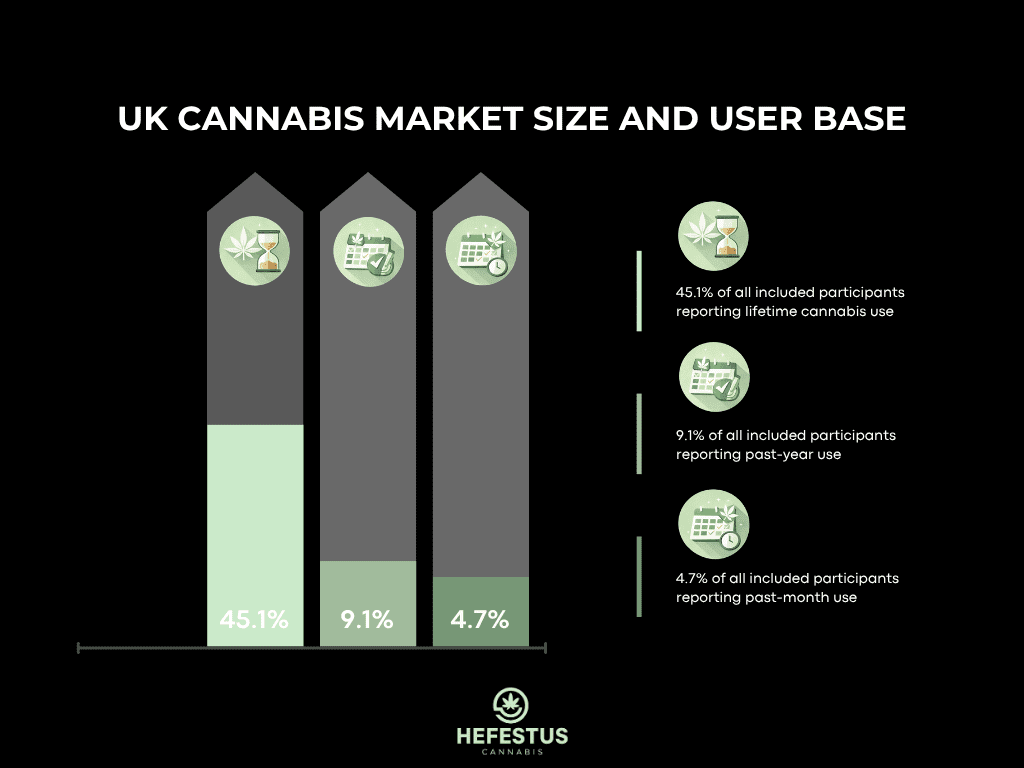
Insight: The market is broad, consistent and supported by both official and alternative data sources.
2. Long-Term UK Cannabis Use Trends (2000-2025)
Cannabis use in the UK has shifted over time, moving from higher peak levels to more stable and predictable patterns. Recent data shows gradual declines from early highs, followed by steady usage levels in the last decade.
- Cannabis use exceeded 10% in the early 2000s among adults aged 16 to 59 (Statista).
- Use declined to 7.6% in 2022/23 (Statista).
- It declined further to 6.8% in 2023/24 (Statista).
- 7.6% of adults used cannabis in 2023 (ONC).
- 6.5% used cannabis in 2025 (ONC).
- 6.3% of adults used cannabis in 2013 (ONC).
- This increased to 7.6% in 2023, showing mid-term growth (ONC).
- Among young adults, cannabis use fell from 18.7% in 2020 to 15.4% in 2023 (ONC).
- It reached 12.5% among 16 to 24-year-olds in 2025 (ONC).
- Weekly cannabis use among young adults dropped to 7.3%, more than half the 2002 level (BBC).
- Any drug use among 16 to 24-year-olds peaked at 31.8% in 1997 (ONC).
- The drug use among 16 to 24-year-olds fell to 15.1% in 2025 (ONC).
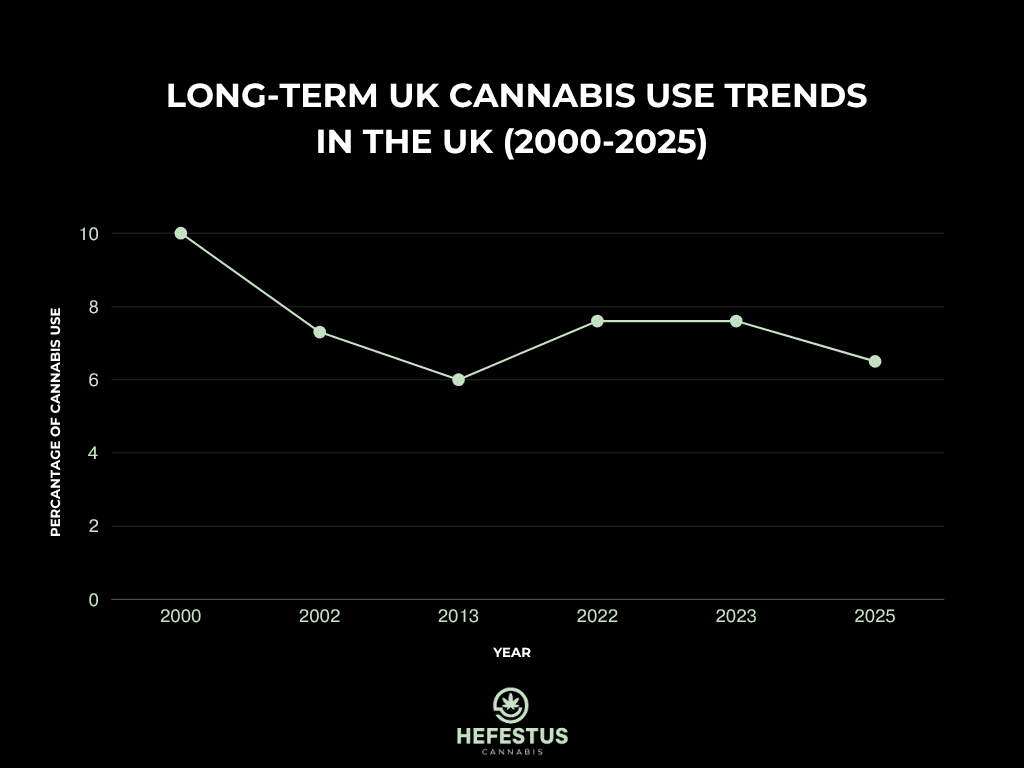
Insight: The market has stabilised. Usage is lower than early peaks but remains consistent and predictable.
3. Consumer Frequency, Repeat Use and Usage Intensity
Usage patterns show that a significant portion of cannabis consumers engage regularly rather than occasionally. This repeat behaviour plays a key role in sustaining overall market demand.
- 35.4% of cannabis users consumed more than once a month in 2023 (ONC).
- 8.3% used cannabis daily in 2023 (ONC).
- 36.5% consumed more than once a month in 2025 (ONC).
- 10.4% used cannabis daily in 2025 (ONC).
- Around 34% of users consumed cannabis monthly or more often (Priory).
- Around 10% of users consume cannabis daily now (Priory).
- 70% of drug users were infrequent users in 2023 (ONC).
- 71.8% of users were infrequent in 2025 (ONC).
- 4.7% of young adults were frequent users in 2023 (ONC).
- 3.5% were frequent users in 2025 (ONC).
- Average consumption reached 206 THC units per week in one UK study. This equals around 10 to 17 joints at 20% THC (University of Bath).
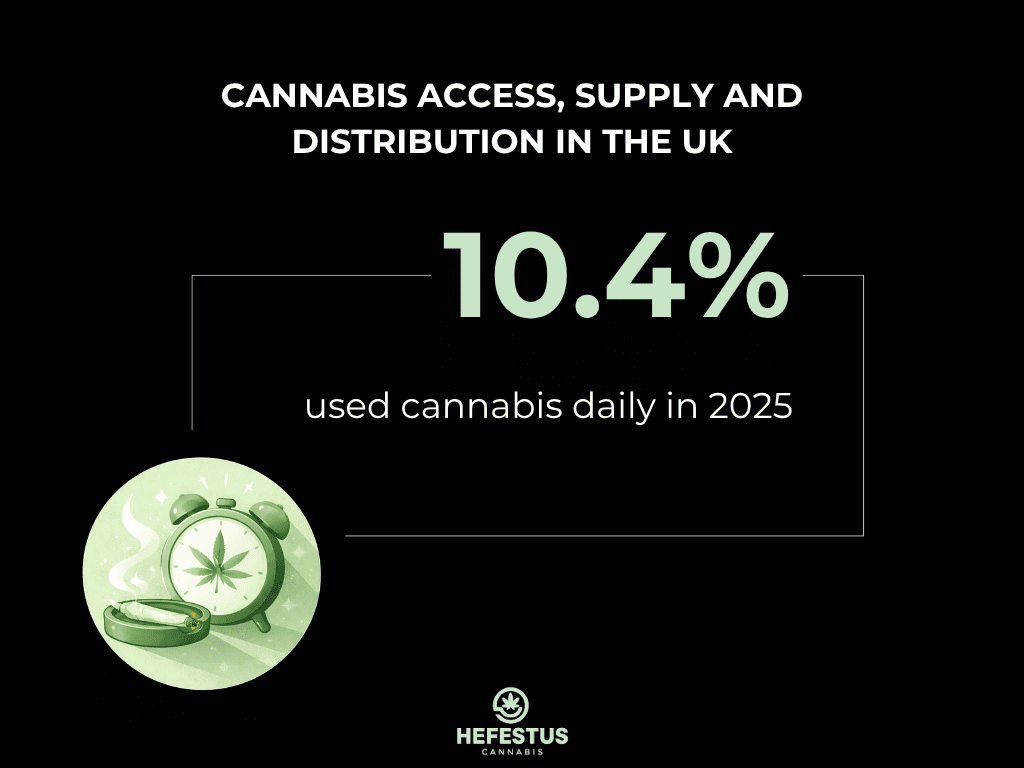
Insight: A large share of the market is repeat-driven. Regular consumption supports consistent product demand.
4. Age, Gender, Income and Regional Cannabis Patterns
Cannabis use in the UK shows clear variation across age groups, income levels and regions. The data highlights where demand is most concentrated and how different segments behave.
- 13.8% of adults aged 16 to 24 used cannabis in 2024 (Releaf).
- 7.2% of adults aged 25 to 59 used cannabis in the same year (Releaf).
- 15.4% of young adults used cannabis in 2023 (ONC).
- 12.5% used cannabis in 2025 (ONC).
- 16.2% of young adults used cannabis in the last year (Providence Projects).
- 6% of school pupils aged 11 to 15 used cannabis in 2023 (NHS England).
- 17% of pupils reported being offered cannabis (NHS England).
- 77% of early users at age 14 used cannabis (GOV).
- 72% of early users at age 15 used cannabis (GOV).
- 56% of recreational users were men (NLM).
- 61.7% of medical users were men (NLM).
- Cannabis use disorder is twice as high in men as in women (ScienceDirect).
- 56.00% of recreational users were men and 33.75% were women (NLM).
- 61.70% of medical users were men and 32.10% were women (NLM).
- 13.6% of low-income individuals used drugs in 2023 (ONC).
- 11.6% of low-income individuals used cannabis (ONC).
- 10.9% of low-income individuals used cannabis in 2025 (ONC).
- 13.2% cannabis use is reported in low-income groups in another dataset (Providence Projects).
- 13.7% of single individuals used drugs in 2025 (ONC).
- 4.3% of married individuals used drugs (ONC).
- South West England recorded 8.2% cannabis use (Russell Webster).
- London recorded 7.2% (Russell Webster).
- North West England recorded 7.1% (Russell Webster).
- East Midlands recorded around 5% (Russell Webster).
- West Country usage was over 1.5 times higher than East Midlands (Russell Webster).
- Medical users skew older than recreational users (NLM).
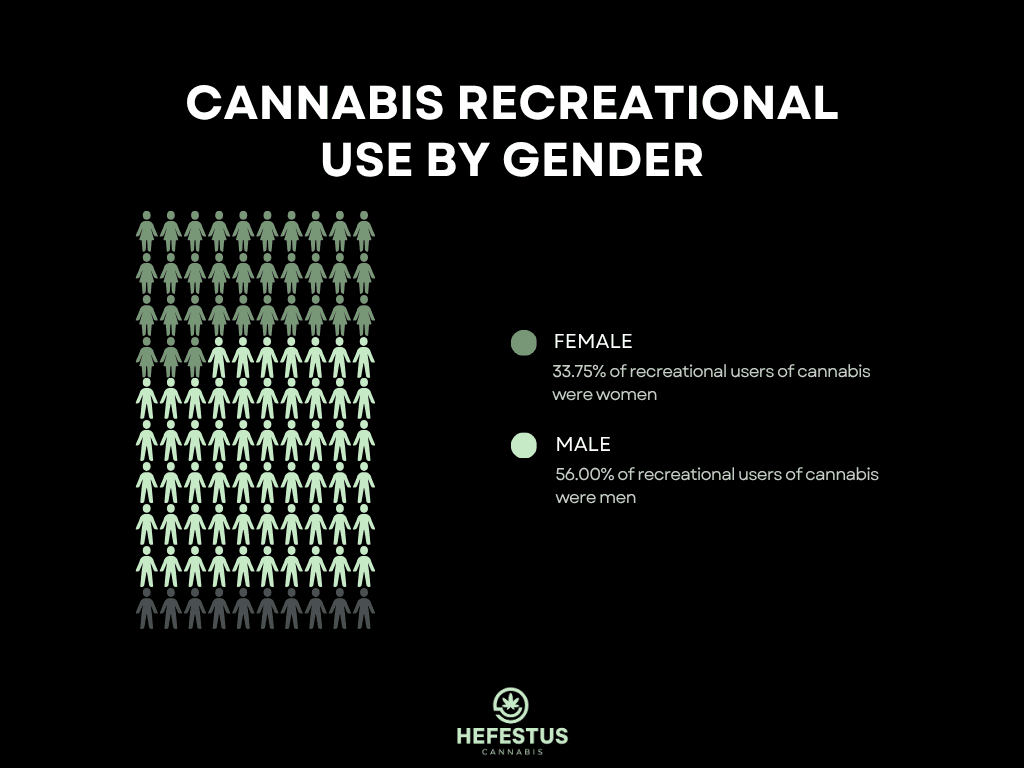
Insight: Usage is concentrated in younger, lower-income and specific regional groups.
5. Medical Cannabis in the UK
Medical cannabis in the UK has expanded steadily since legalisation, with patient numbers and infrastructure growing year by year. However, access remains limited compared to total demand.
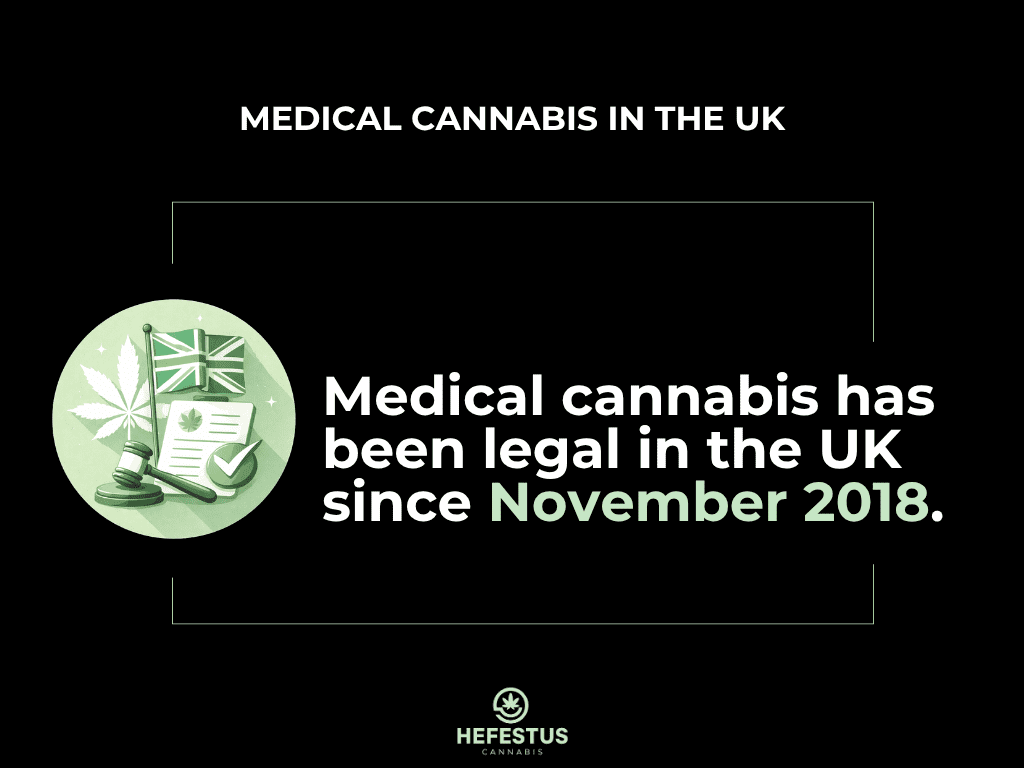
- Medical cannabis has been legal in the UK since November 2018 (NLM).
- The estimated UK medical cannabis patient statistics for 2024 sat at around 50,000 to 60,000 active patients, pushing cannabis prescription numbers in the UK towards 80,000 by the end of 2025. (Releaf)
- Clinics process around 1,000 new patients per month (Releaf).
- More than 99% of prescriptions are issued privately (Releaf).
- Around 20 to 25 specialist clinics operate in the UK (Releaf).
- More than 426 licensed cannabis products are available (Releaf).
- Fewer than 250 patients were active in 2019 (Statista).
- Awareness remains limited, with 16.5 million adults believing cannabis is illegal (Releaf).
- Only 41.5% know it can be prescribed (Releaf).
Insight: The legal market is expanding quickly but remains small relative to total demand.
6. Medical Cannabis Conditions and Market Growth
Medical cannabis is used across a growing range of conditions, although NHS access remains tightly restricted. Private prescribing continues to drive expansion.
- NHS prescriptions are limited to epilepsy, MS spasticity and chemotherapy-related nausea (Releaf).
- Private prescriptions cover pain, psychiatric, neurological and sleep conditions (Releaf).
- More than 50% of adults may qualify for treatment (Releaf).
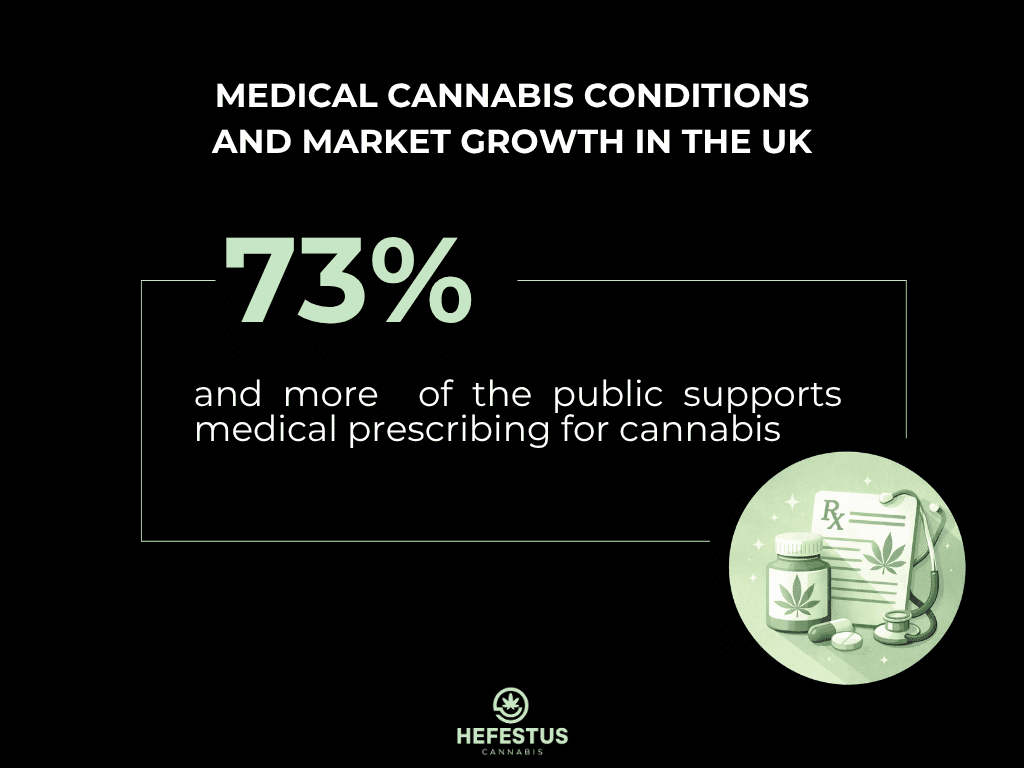
- Over 73% of the public supports medical prescribing (Releaf).
- The UK medical cannabis market is valued at £300 million (Priory).
Insight: The UK market is growing but still has significant expansion potential.
7. Treatment, Dependence and Health Indicators
Cannabis contributes to treatment demand and shows measurable levels of dependence across the population. The data highlights both usage impact and healthcare involvement.
- 329,646 adults were in treatment in 2024 to 2025 (GOV).
- 21% of those reported cannabis problems (GOV).
- 22% of new entrants reported cannabis issues (GOV).
- 21.4% of entrants reported cannabis problems in 2023 to 2024 (GOV).
- 87% of young people in treatment used cannabis (GOV).
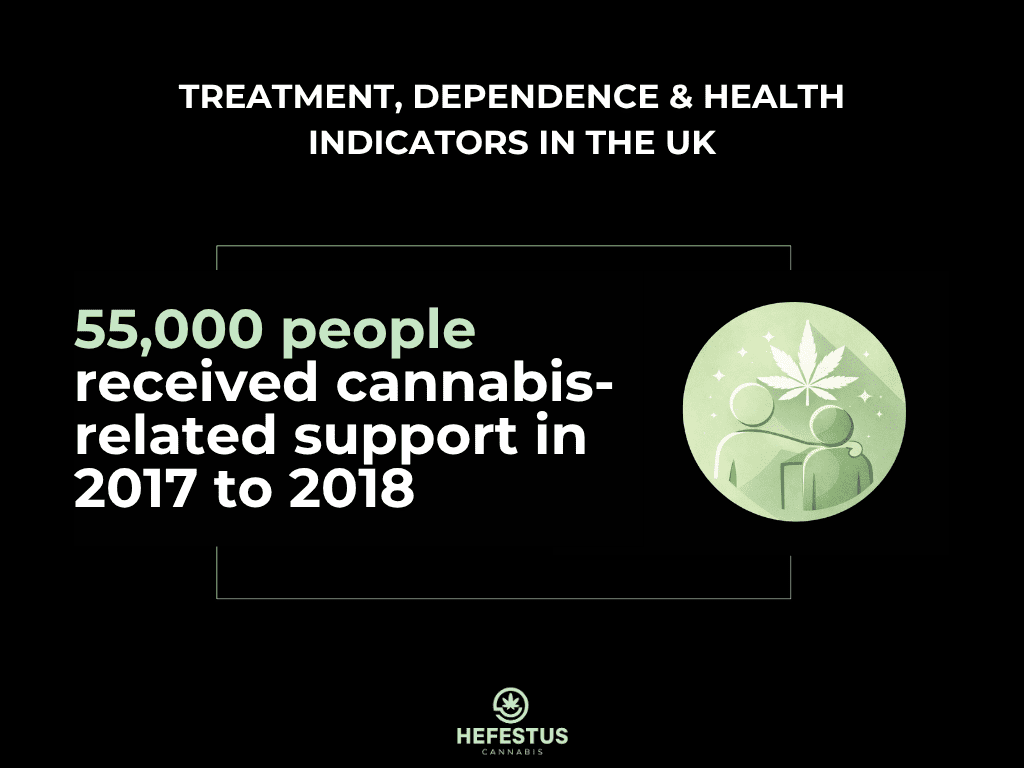
- 55,000 people received cannabis-related support in 2017 to 2018 (BBC).
- 10% of users develop dependence (Releaf).
- 2.3% of adults show cannabis dependence (ONC).
- 6.7% show overall drug dependence (ONC).
- Cannabis dependence rose from 2.8% in 2014 to 5.4% in 2024 (WRD).
- 74% of treatment entrants reported mental health needs (GOV).
Insight: Cannabis plays a significant role in treatment demand and health-related outcomes.
8. Access, Supply and Distribution
Cannabis access in the UK remains widespread despite legal restrictions. Supply channels and enforcement data show consistent availability across the country.
- Cannabis has been illegal in the UK since 1928 (BBC).
- Possession can carry up to five years in prison (Catch22).
- Over 130,000 possession incidents were recorded in 2021 (Releaf).
- Over 1,300 people were imprisoned for cannabis offences in 2018 (Releaf).
- Over 152,000 cannabis seizures occurred in 2024 (Releaf).
- Cannabis appeared in 70% of drug seizures (Releaf).
- 74 tonnes were seized by Border Force (Releaf).
- 36,000 kg were seized in 2017 to 2018 (BBC).
- Most seizures involve under 5 grams (BBC).
- 45.7% of users obtain cannabis via social contacts (ONC).
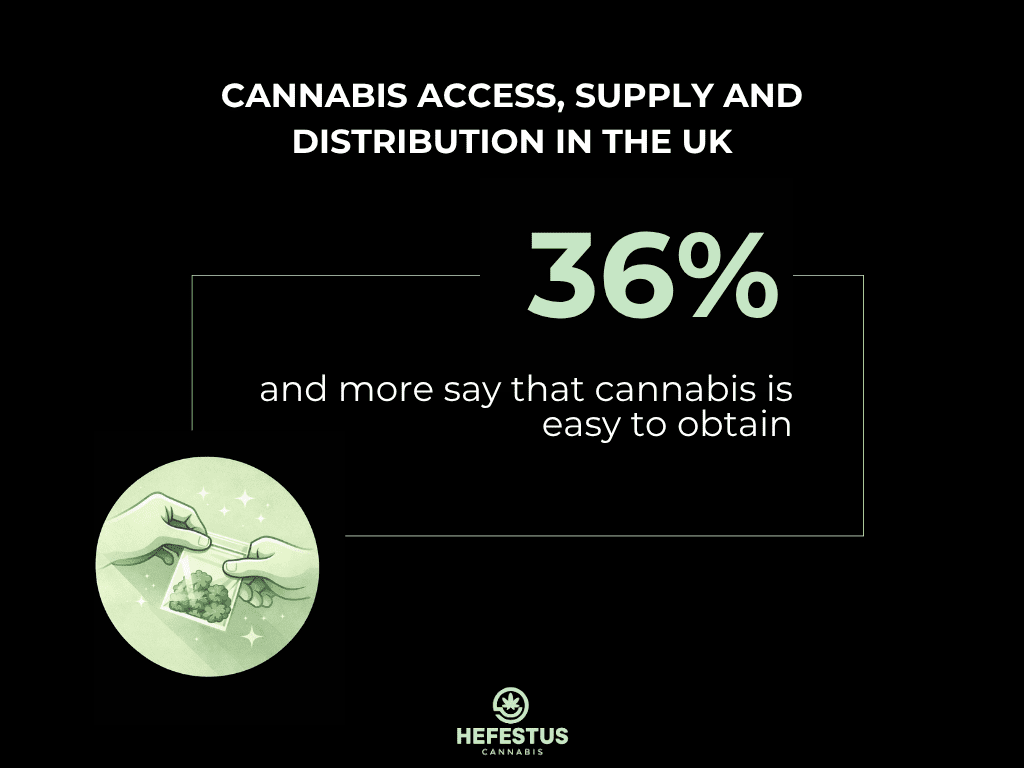
- Around 36% say cannabis is easy to obtain (ONC).
Insight: Access remains widespread and embedded in social networks.
9. Economic Impact and Market Signals
The cannabis market already represents a measurable economic footprint in the UK. Spending, enforcement costs and production data all point to significant market activity.
- The UK medical cannabis market is valued at £300 million (Priory).
- Billions are spent annually on illicit cannabis (Releaf).
- Legalisation could save £200 million in policing costs (Releaf).
- Total prohibition costs may reach £890 million annually (Releaf).
- The UK produced 44% of global medical cannabis supply in 2016 (BBC).
Insight: The economic footprint is already large, with further growth potential.
Conclusion
The latest cannabis use statistics in the UK show a large and well-established market, with millions of active users and tens of millions reporting lifetime exposure. Usage levels have stabilised in recent years, following earlier peaks, and now reflect a consistent and predictable pattern across age groups and regions.
A significant share of consumption is driven by repeat users, supporting ongoing demand and reinforcing the market’s structural stability. At the same time, the legal medical cannabis sector is expanding steadily, although it still represents only a small portion of total usage.
Access, supply and consumption are already embedded in everyday behaviour, indicating that the market is mature rather than emerging. Economic data further confirms that cannabis represents a substantial and active segment, with clear signals of long-term sustainability.
These cannabis use statistics in the UK confirm a market that is established, structured and positioned for continued growth across both consumer and medical segments.