How to Choose a Form Fill Seal Machine
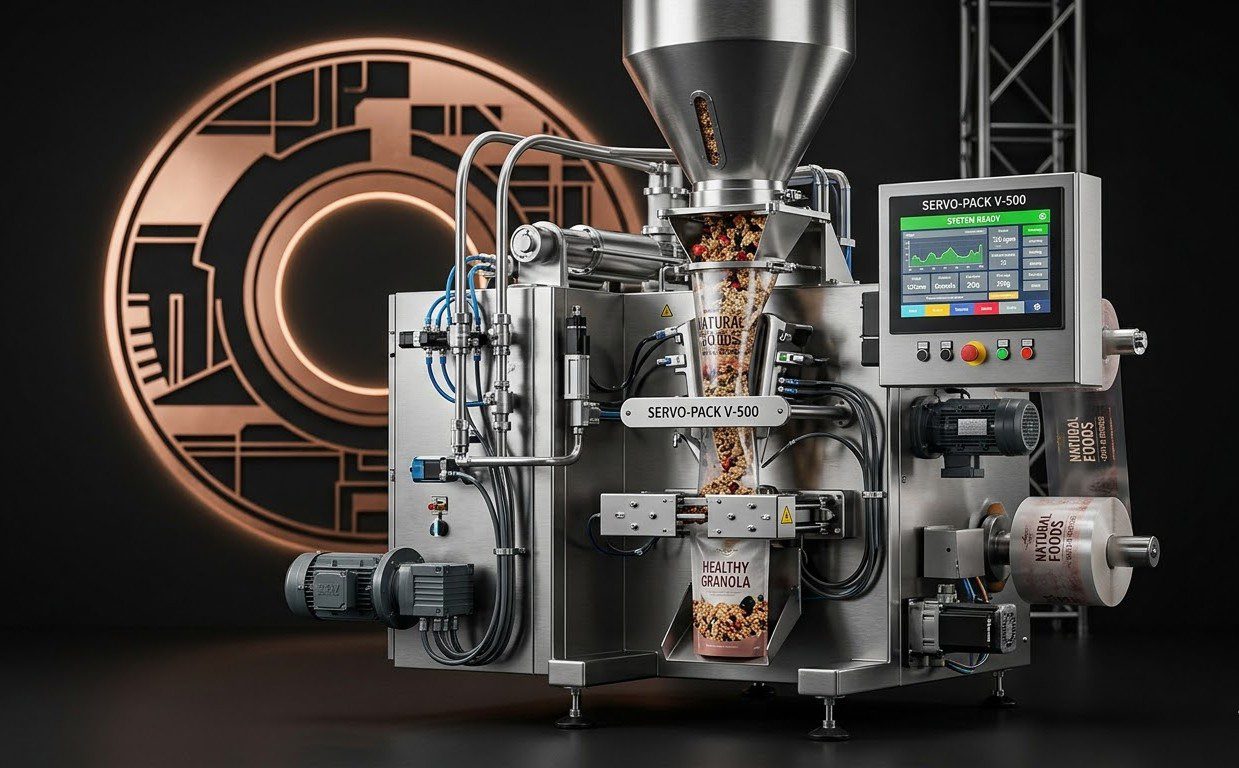
Choosing a Form Fill Seal (FFS) machine isn’t just a purchasing decision — it’s a production architecture decision that can affect your packaging line for the next 5–15 years.
Many manufacturers approach the process backward. They compare machine speed, features, and price before confirming whether the machine type, dosing system, and line integration actually fit their production environment.
That’s why many packaging automation projects fail after installation, not during procurement.
This guide explains how to choose a Form Fill Seal machine by focusing on risk avoidance, product compatibility, and line-level performance, rather than simply comparing specifications.
Common Mistakes When Choosing a Form Fill Seal Machine
Most buyers start by comparing machine specs: speed, price, bag formats, and automation features.
Experienced packaging engineers start somewhere else — failure points.
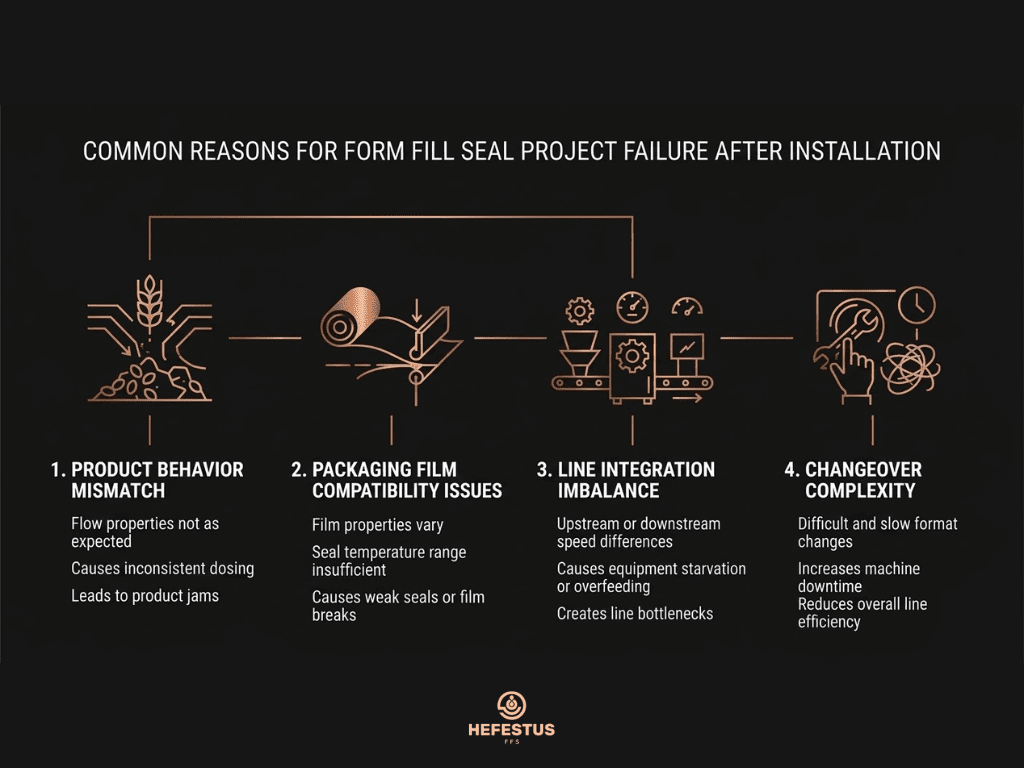
In many cases, Form Fill Seal systems don’t fail during purchase. They fail six to twelve months after installation, when real production conditions expose hidden weaknesses in the machine selection process.
Why most FFS purchases fail after installation
Packaging automation projects rarely collapse because of a single mechanical issue. More often, problems originate during machine selection, when key operational variables are underestimated.
Common causes include:
- Product behavior was not tested under real production conditions, meaning powders, granules, or liquids behave differently at full line speed.
- Packaging material compatibility was assumed, leading to weak seals, film tracking problems, or excess packaging waste.
- Upstream and downstream equipment were evaluated separately, creating flow imbalances between fillers, conveyors, and the FFS machine.
- Changeover complexity was underestimated, especially in multi-SKU production environments.
A machine that performs perfectly in a showroom demo can still struggle once it meets the realities of your actual product flow, operators, and production schedule.
The real cost of choosing “flexible” instead of “fit-for-purpose”
Many buyers prioritize flexibility, assuming that a machine capable of handling multiple products will provide greater long-term value.
In practice, the opposite often happens. Machines designed for many use cases frequently perform worse in each individual one.
Typical trade-offs include:
- dosing accuracy drops when switching between powders and granules
- sealing performance declines when film thickness varies
- changeovers introduce operator errors and downtime
In high-volume packaging environments, specialized machines almost always outperform flexible ones, delivering higher speeds, lower waste, and more consistent production.
When an FFS machine becomes a bottleneck instead of a solution
Packaging automation is intended to increase throughput, but poorly matched machines often become the slowest part of the line.
This happens when:
- the dosing system cannot match the machine’s rated speed
- film tracking problems cause repeated stoppages
- operators struggle with adjustments or changeovers
Instead of improving productivity, the machine limits it. A proper selection process focuses on balancing the entire packaging line, not simply choosing the fastest machine.
Step 1: Confirm FFS Is the Right Architecture (Before You Compare Models)
Not every product should be packaged with Form Fill Seal technology. Choosing the wrong architecture can create expensive operational problems.
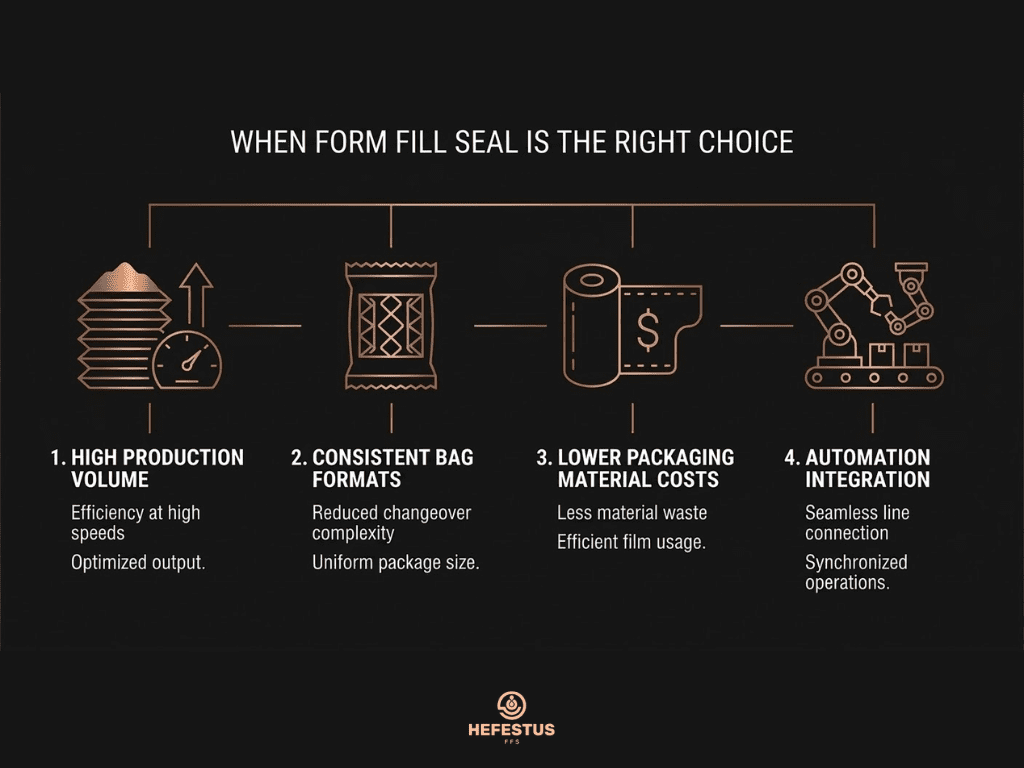
When Form Fill Seal Makes Sense
FFS systems perform best in production environments with predictable packaging conditions and sufficient volume to justify automation.
FFS machines are typically the right choice when:
- You package high-volume food products.
Industries such as snacks, coffee, rice, pet food, and frozen foods rely heavily on Vertical Form Fill Seal (VFFS) machines because they package products quickly using roll stock film. Typical speeds range from 60–200 packages per minute. - Your packaging formats are consistent.
When products use a limited number of bag formats — such as pillow bags or stand-up pouches — FFS machines can run efficiently with minimal adjustments. - Packaging material cost is critical.
Roll stock film is typically 20–40% cheaper than premade pouches, making FFS systems attractive for cost-sensitive production environments. - Your production line is automation-driven.
FFS machines integrate easily with multihead weighers, auger fillers, conveyors, checkweighers, and robotic case packers.
When these conditions are present, FFS machines deliver high throughput, lower packaging costs, and reliable long-term performance.
When FFS Is the Wrong Choice
Form Fill Seal systems are powerful but not universal.
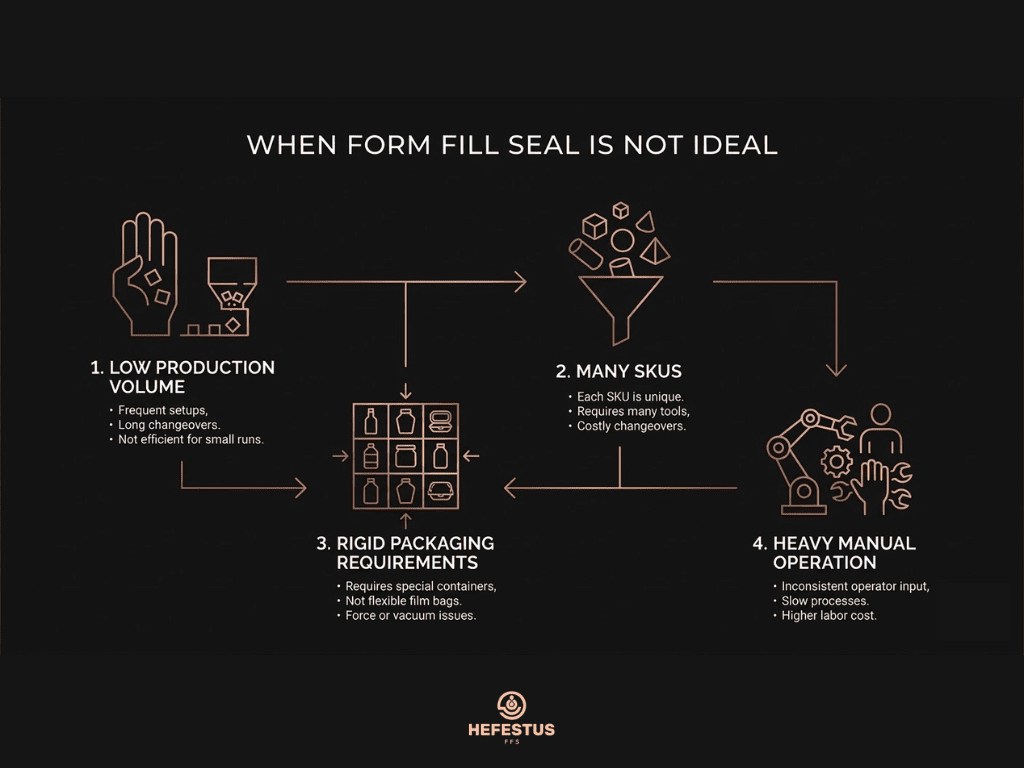
They may not be ideal when:
- Your facility runs many SKUs.
Premade pouch machines often allow faster changeovers. - Production volumes are very low.
Small batch manufacturing may not justify a fully automated FFS system. - Your product requires rigid containers.
FFS machines are designed for flexible packaging, not bottles, jars, or rigid trays. - Your process requires frequent manual adjustments.
Heavy operator intervention reduces the benefits of automation.
Many vendors avoid discussing these limitations because they reduce potential sales. However, selecting the wrong packaging architecture often leads to far greater long-term costs than the machine itself.
Step 2: Match the Machine to Your Product Physics
The most important factor when choosing a Form Fill Seal machine is how your product behaves during packaging.
Product characteristics influence everything from filling accuracy to sealing reliability. A machine that works well for one product category may perform poorly for another—even if the packaging format appears similar.
Understanding these dynamics early prevents costly adjustments after installation.
Product State (This Drives Everything)
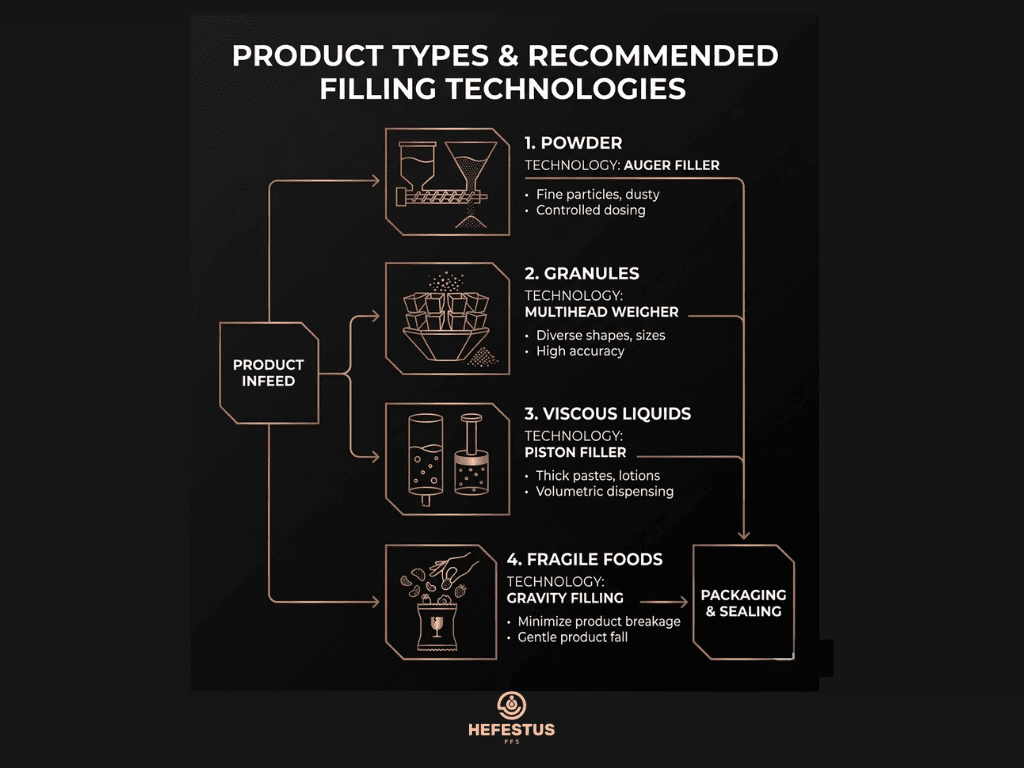
Different product types require different filling technologies and sealing strategies. Before selecting a machine, evaluate how the product flows, settles, and reacts during packaging.
Key factors include:
- Free-flowing powders.
Products like sugar, flour, and protein powder typically require auger fillers to maintain dosing accuracy. Powder packaging also requires dust control, since airborne particles can contaminate seals and weaken package integrity. - Sticky or viscous products.
Liquids such as sauces, lotions, gels, or detergents are usually handled with piston pump fillers designed for thicker materials. These systems maintain consistent dosing while preventing leaks. - Fragile inclusions.
Products containing delicate ingredients—such as nuts, cereal clusters, or dried fruit—must avoid mechanical damage during filling. Controlled gravity-based filling helps preserve product structure. - Oxygen- or moisture-sensitive foods.
Products like coffee or dehydrated foods may require Modified Atmosphere Packaging (MAP) to maintain freshness. This requires machines capable of gas flushing and specialized sealing.
Selecting filling technology that matches the product’s physical behavior is one of the most important steps in choosing an FFS machine.
Why “One Machine for Everything” Is a Lie
Many suppliers promote machines designed to handle a wide range of products and packaging styles. While appealing in theory, packaging systems always involve trade-offs.
Machines optimized for multiple use cases often sacrifice performance.
Common limitations include:
- Dosing system limitations.
Each filling system is designed for a specific product type. A filler optimized for powders rarely delivers equal accuracy with liquids or granules. - Seal contamination risks.
Powders or particles near the sealing area can weaken seals and cause package leakage. - Speed vs. accuracy trade-offs.
Increasing speed often reduces dosing precision and increases product giveaway.
For high-volume operations, machines designed around specific product behavior typically outperform universal solutions.
Step 3: Vertical vs Horizontal FFS (The Real Decision Criteria)
The most common comparison in packaging automation is Vertical Form Fill Seal (VFFS) versus Horizontal Form Fill Seal (HFFS) machines.
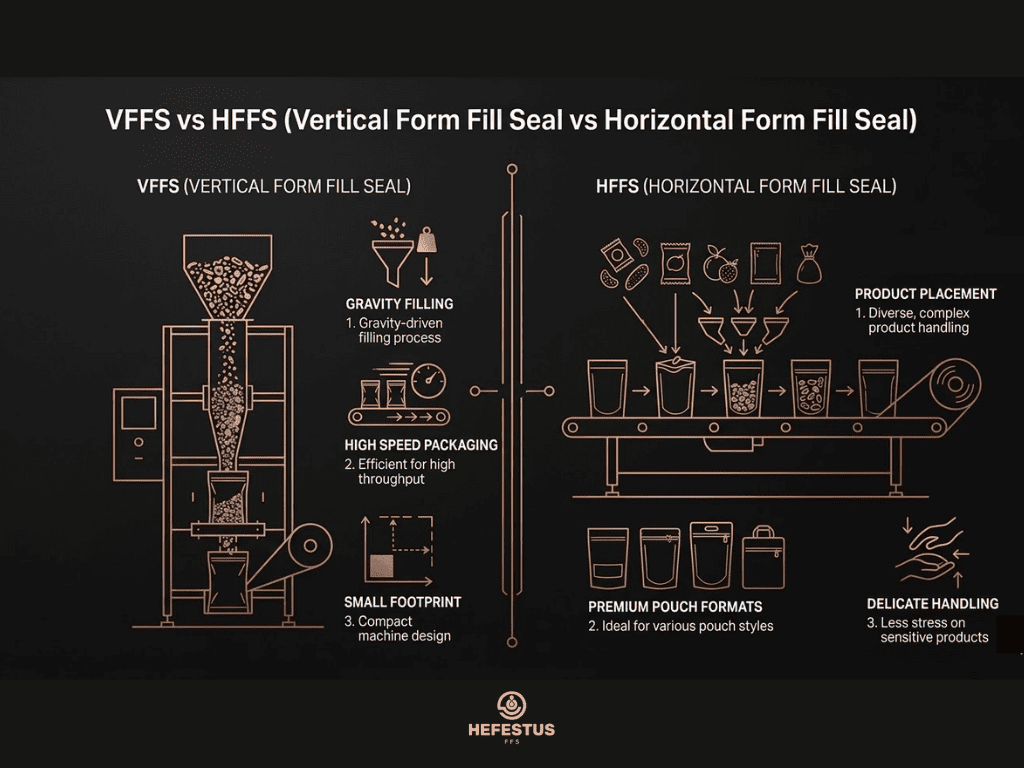
While the mechanical difference is simple—vertical machines fill from above and horizontal machines form pouches sideways—the correct choice depends on product characteristics, packaging format, and production goals.
The real question is not which machine is better, but which architecture fits your process.
Choose VFFS If:
Vertical Form Fill Seal machines are ideal when products flow naturally and production efficiency is the priority.
VFFS systems work best when:
- Gravity filling works well.
Products like snacks, grains, powders, coffee, or rice flow easily into vertical bags. - Floor space is limited.
Vertical machines usually require a smaller footprint than horizontal systems. - Cost per package is a priority.
VFFS machines use roll stock film efficiently and often achieve speeds of 60–200 packages per minute.
For this reason, VFFS machines are widely used in snack foods, pet food, grains, and powdered products.
Choose HFFS If:
Horizontal Form Fill Seal machines are typically used when packaging presentation or product handling requires more control.
HFFS systems are often preferred when:
- Product orientation matters.
Delicate items such as baked goods or medical products require controlled horizontal placement. - Advanced sealing or MAP is required.
Horizontal machines often support complex sealing systems and gas flushing. - Shelf presentation affects sales.
Premium pouch styles are often easier to produce with horizontal pouch-forming systems.
Many vendors explain the mechanical differences between VFFS and HFFS machines.
The more important question is which machine introduces the least risk in your production environment.
Step 4: Throughput vs Flexibility (Pick One to Optimize)
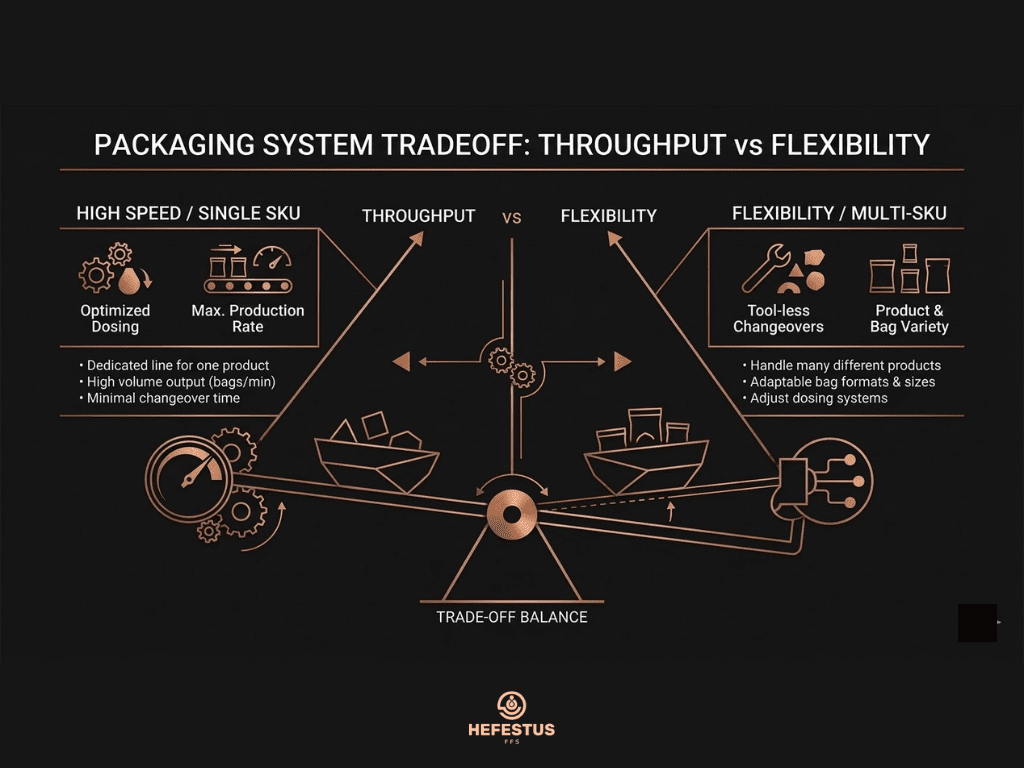
Packaging systems rarely maximize both speed and flexibility. Most machines are designed to optimize one of these priorities.
Before choosing an FFS system, determine whether your operation requires maximum throughput or frequent product changeovers.
High-Speed, Single-SKU Lines
Production lines focused on a single product typically prioritize speed and consistency.
High-speed lines often include:
- Continuous motion systems, which eliminate stop-start cycles and increase throughput
- Servo-driven sealing jaws, improving precision and sealing consistency
- Automated film tracking, maintaining alignment during high-speed operation
These systems achieve very high speeds but perform best when packaging formats remain consistent.
Multi-SKU, Short-Run Production
Facilities producing many product variations require more flexibility.
Machines designed for multi-SKU environments often include:
- Tool-less changeovers, allowing operators to switch bag formats quickly
- Programmable HMI recipes, storing settings for different products
- Modular forming components, enabling rapid packaging adjustments
Although these machines may not reach the absolute top speeds of specialized systems, they reduce downtime during product transitions.
Step 5: Sanitation, Washdown & Food Safety (Where Bad Machines Get Exposed)
In food production environments, sanitation requirements quickly expose design flaws. Equipment that performs well during installation may struggle once it is subjected to daily washdowns and strict hygiene standards.
For this reason, hygienic design is not optional in food packaging.
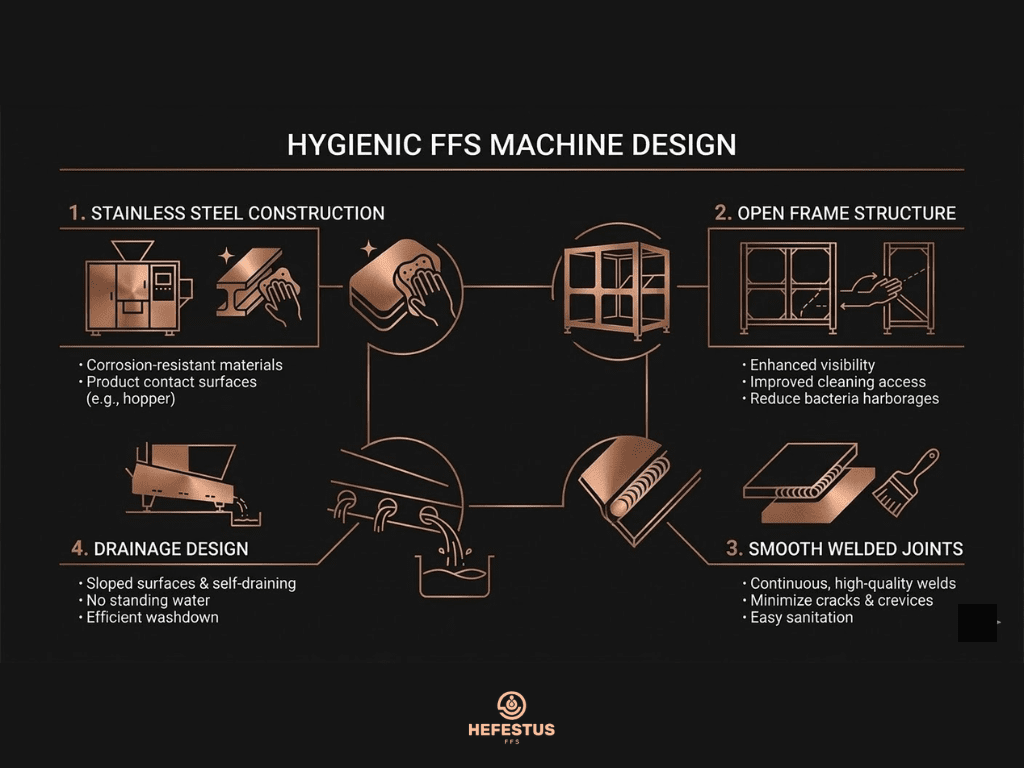
Hygienic Design Isn’t Optional in Food
Machines used in food processing must support frequent cleaning while minimizing contamination risks.
Well-designed Form Fill Seal machines typically include:
- Stainless steel construction for corrosion resistance
- Open-frame designs that allow easier cleaning and inspection
- Smooth welded joints instead of bolted frames, reducing contamination points
- Proper drainage channels to prevent water buildup
These features simplify sanitation procedures and help maintain food safety compliance.
Questions Competitors Don’t Want You Asking
When evaluating equipment, sanitation performance should be discussed directly with the supplier.
Important questions include:
- Can the machine tolerate daily washdowns without damaging components?
- How long does a full sanitation cycle take?
- Which components typically fail first in wet environments?
Machines that cannot withstand rigorous cleaning often develop mechanical issues prematurely, increasing maintenance costs and downtime.
Step 6: Labor Reality Check (Design for the Workforce You Actually Have)
Automation changes how packaging lines operate, but it does not eliminate labor challenges.
In many facilities, the real constraint is not machine capability—it is how easily operators can run and maintain the equipment.
Why Operator Skill Is a Hidden Cost
Packaging operations frequently deal with:
- Operator turnover, requiring constant retraining
- Long training periods for complex machines
- Errors during changeovers between products
These factors increase downtime and reduce production consistency.
What to Look For
Machines designed for real production environments reduce operator dependency through features such as:
- Intuitive HMIs, allowing operators to quickly understand machine status
- Recipe-based automation, automatically loading settings during changeovers
- Minimal manual adjustments, reducing setup complexity
When machines are easy to operate, packaging lines remain stable even with frequent staff changes.
Step 7: Automation & Line Integration (FFS Doesn’t Live Alone)
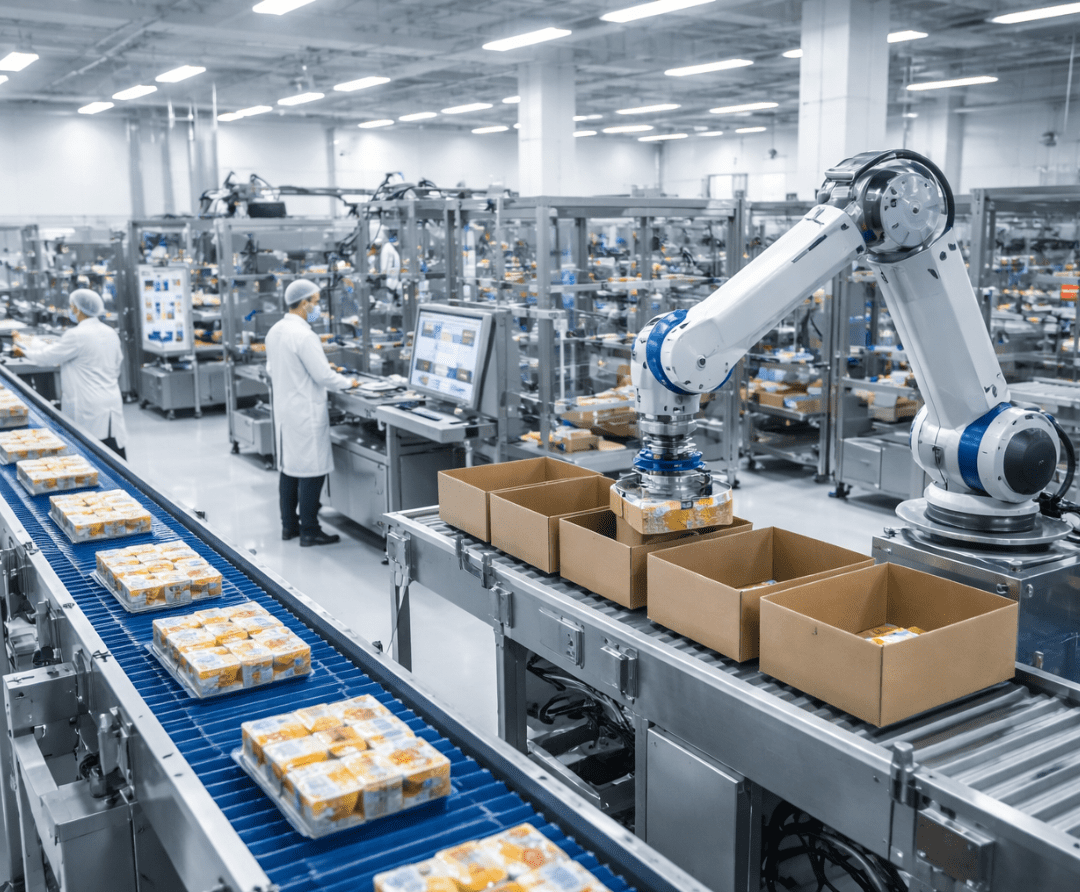
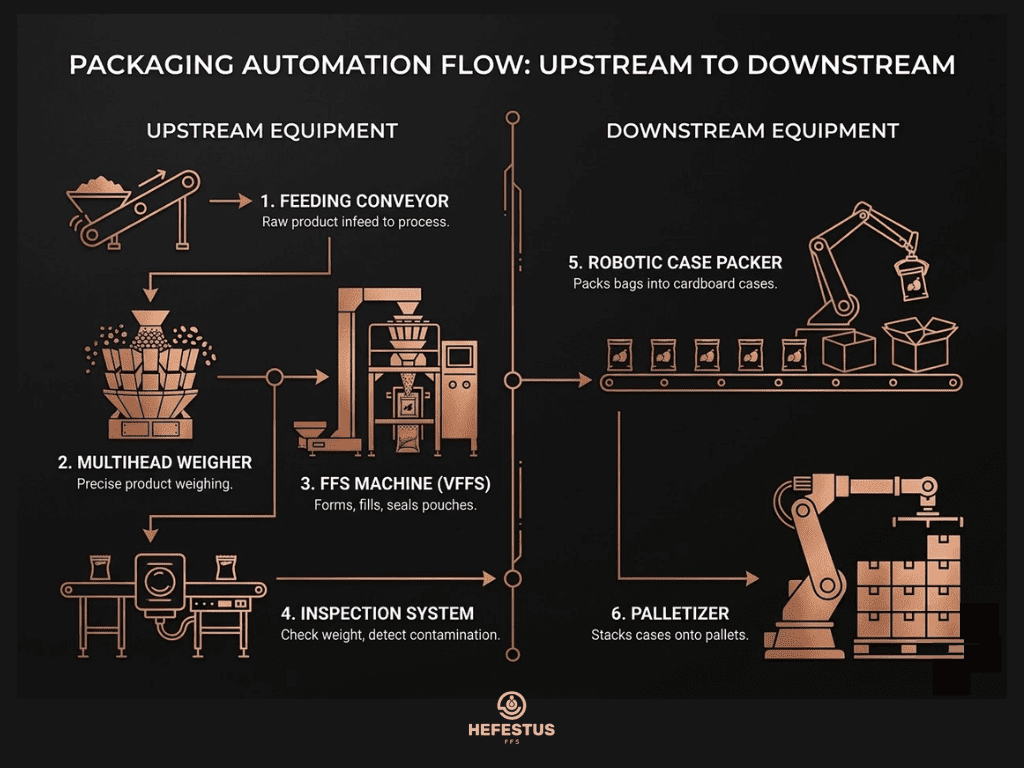
A Form Fill Seal machine should never be evaluated as a standalone piece of equipment. In real production environments, it operates as part of a larger packaging system that includes product feeding, dosing, inspection, and case packing.
If the machine is not properly integrated with these surrounding systems, even a high-performance FFS machine can struggle to reach its intended speed or reliability.
Upstream Compatibility
Before the product reaches the Form Fill Seal machine, it typically passes through equipment responsible for feeding, measuring, and stabilizing product flow.
Common upstream equipment includes:
- Feeding conveyors, which move product from processing equipment into the packaging line
- Multihead weighers, commonly used for snacks, grains, and frozen foods to ensure precise dosing
- Auger fillers, designed for powders such as flour, spices, or nutritional supplements
- Product buffering systems, which regulate product flow and prevent interruptions during packaging
If these systems are not synchronized with the FFS machine, product delivery becomes inconsistent. This often leads to frequent stops or forces the packaging machine to operate below its rated speed.
Downstream Compatibility
After a package is filled and sealed, it typically moves through additional automation stages before shipping.
Common downstream equipment includes:
- Modified Atmosphere Packaging (MAP) systems, which replace oxygen inside the package to extend shelf life
- Sealing inspection systems, which verify package integrity and detect defects
- Robotic case packers, which group packages into cartons for shipping
- Palletizing systems, which prepare finished cases for transport and storage
When upstream and downstream equipment are properly integrated, the entire packaging line operates as a coordinated system rather than a collection of individual machines.
In most cases, improving the performance of the entire line delivers far greater efficiency gains than optimizing a single machine.
Step 8: CAPEX vs OPEX (The Math Buyers Rarely Do)
When manufacturers evaluate packaging equipment, the discussion often focuses on capital expenditure (CAPEX)—the upfront cost of the machine.
However, the long-term financial impact of a Form Fill Seal system usually comes from operating expenses (OPEX).
The purchase price is only the starting point. The real costs—or savings—appear once the machine becomes part of daily production.
What Low-Cost Machines Cost You Later
Lower-priced machines may seem attractive initially, but they often introduce hidden operational costs.
Common long-term issues include:
- Increased downtime, caused by mechanical failures or unstable film handling
- Higher packaging film waste, resulting from poor sealing control or inaccurate film tracking
- Additional labor requirements, when operators must frequently intervene to correct machine problems
- Growing maintenance expenses, as components wear out faster and require frequent replacement
Over time, these costs can exceed the initial machine purchase price. What appears to be a budget-friendly decision can become the most expensive option on the production line.
How to Estimate True ROI
Instead of focusing solely on machine price, manufacturers should evaluate the total cost of ownership.
Important metrics include:
- Cost per packaged unit, which measures how efficiently the machine converts materials and labor into finished products
- Overall Equipment Effectiveness (OEE), which evaluates machine availability, performance, and quality
- Maintenance costs over time, including spare parts, servicing, and downtime
- Scalability, ensuring the machine can support increased production demand in the future
Machines with higher upfront costs often deliver stronger ROI because they reduce downtime, minimize waste, and maintain consistent production speeds.
Step 9: The Vendor Test (How to Tell If You’re Buying a Partner or a Problem)
Choosing the right Form Fill Seal machine also means choosing the right equipment supplier.
The vendor behind the machine often determines whether the project becomes a long-term success or an ongoing operational challenge.
A strong supplier should help ensure the machine works effectively within your entire production environment, not simply deliver equipment.
Pre-Sale Red Flags
Certain warning signs can indicate that a supplier lacks the experience needed to support your packaging application.
Common red flags include:
- No product testing before purchase, meaning the supplier has not validated machine performance with your actual materials
- Vague performance guarantees, where speed or accuracy claims are not supported by measurable data
- Generic case studies instead of real references, making it difficult to confirm experience with similar products
These issues often lead to integration problems once the machine is installed.
What Serious OEMs Provide
Experienced packaging equipment manufacturers approach projects differently. Instead of simply selling machines, they focus on ensuring the system performs reliably within the full packaging line.
Strong OEM partners typically provide:
- Application testing using your actual product and packaging materials
- Packaging line design input, helping coordinate upstream and downstream equipment
- Long-term service strategies, including spare parts planning, preventive maintenance, and technical support
This collaborative approach reduces risk and improves long-term system performance.
Final Decision Checklist
Before committing to a Form Fill Seal machine, verify that:
- Product compatibility has been tested with the machine
- Required production throughput matches your demand
- Sanitation and food safety requirements are validated
- Operator skill requirements match your workforce
- Automation integration with upstream and downstream equipment is planned
Reviewing these factors helps prevent the most common packaging automation failures.
Closing: Choose for the Line You’re Building, Not the Demo You Saw
The “right” Form Fill Seal machine always depends on context.
A system that works perfectly for a snack manufacturer may perform poorly in a pharmaceutical or personal care production environment. Product behavior, packaging materials, sanitation requirements, and automation needs all influence the decision.
Successful packaging automation projects focus on how the entire line operates together, not just the specifications of a single machine.
Companies that involve an experienced automation partner early in the design process are far more likely to build packaging lines that run reliably for years.
In the end, after learning how to choose a Form Fill Seal machine, you’ll understand it isn’t about selecting the fastest or most feature-rich equipment. It’s about building a packaging system that runs consistently, scales with demand, and supports your production goals every day.