The Science Behind the Perfect Preroll

How engineering discipline, airflow control, and modern automation define the perfect preroll quality at scale.
The perfect preroll doesn’t happen by accident.
Cannabis has been consumed for centuries, but the modern preroll is no longer a handcrafted novelty—it’s a manufactured product with expectations (and your brand legacy) attached. Today’s consumers expect a smooth draw, even burn, intact aroma, and consistent potency every time, whether the joint was produced yesterday or shipped across the country weeks ago.
That expectation creates a hard truth for producers:
Flower quality alone no longer determines the experience. Construction does.
The science behind a perfect preroll lives in airflow, density, particle size, and structural stability. Miss any one of those, and even premium inputs fall apart once the paper is lit.
Why So Many Prerolls Still Disappoint
Ask operators, retailers, or consumers what goes wrong with prerolls, and the answers are familiar:
- Canoeing halfway through
- Tight or inconsistent draw
- Harsh smoke or repeated relighting
- Joints that look perfect but smoke terribly
In most cases, these failures have nothing to do with genetics or potency. They come from inconsistent construction, especially when production scales.
Small-batch hand rolling allows skilled operators to compensate in real time. But once volume increases, human variability creeps in—between people, shifts, and days. That variability shows up downstream as combustion issues, airflow failures, and customer complaints.
To understand why, it helps to understand what a joint actually is.
A Joint Is a Combustion-Driven Vapor System
Despite appearances, cannabinoids and terpenes aren’t delivered by the burning tip itself.
The burn zone functions primarily as a heat source. As air is pulled through the packed flower, that hot air vaporizes cannabinoids and terpenes before they reach the consumer. One industry expert famously described a joint as “a vaporizer with a dirty heat source.”
That framing explains why construction matters so much.
For a perfect preroll to perform correctly, three variables must work together:
- Particle size
- Packing density
- Continuous airflow from tip to filter
When any one of these breaks down, the entire smoking experience degrades.
The Three Physical Components That Define Prefect Preroll Performance
From an engineering perspective, every perfect preroll consists of three functional systems:
1. Paper
The paper controls burn rate, structural integrity, and how oxygen enters the system. Porosity and thickness affect how heat propagates down the joint.
2. Mouthpiece (Filter or Crutch)
The filter maintains airflow at the draw point and prevents collapse. Inconsistent density near the filter is the most common cause of “floppy” or choking joints.
3. Cannabis Fill Material
This is the most complex component. The flower must simultaneously:
- Deliver cannabinoids and terpenes
- Support the structure of the cone
- Create internal air pathways
- Act as the fuel for combustion
All of that depends on particle size and how consistently the material is packed.
Particle Size: The Foundation of Smoke Quality
Particle size has a direct, measurable impact on joint performance.
- Too fine (<1 mm): Restricted airflow, hotter vapor, harsh smoke, frequent relights
- Too coarse (6–10 mm): Poor combustion, uneven burns, tunneling and canoeing
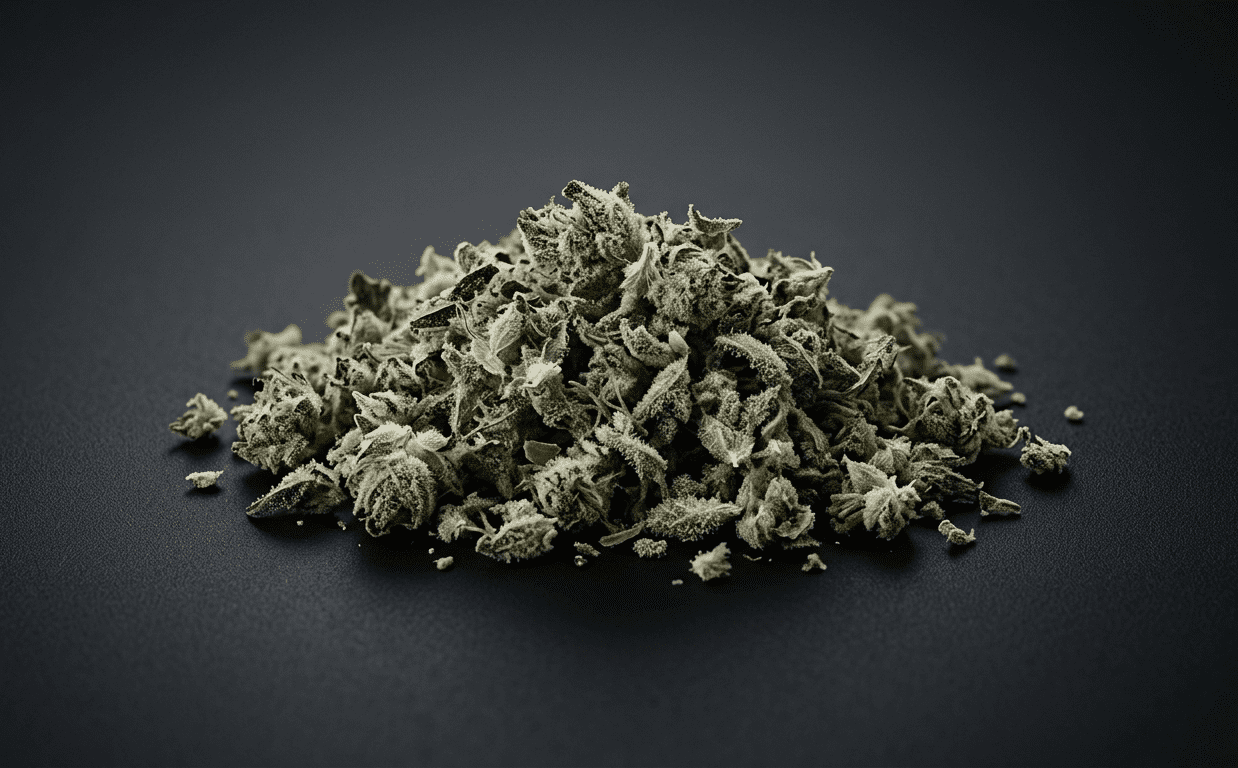
Interestingly, hand-ground flower often performs well because it produces a blend of particle sizes. Those mixed sizes interlock structurally while leaving open airflow channels.
Controlled testing has shown that blended mid-range particle distributions—such as combinations around 2 mm and 6 mm—can closely replicate the smoke characteristics of hand-ground flower, but with far greater consistency.
The problem is scalability.
Hand grinding doesn’t scale. Food processors over-mill. Closed-batch systems generate heat, inconsistency, and stem contamination.
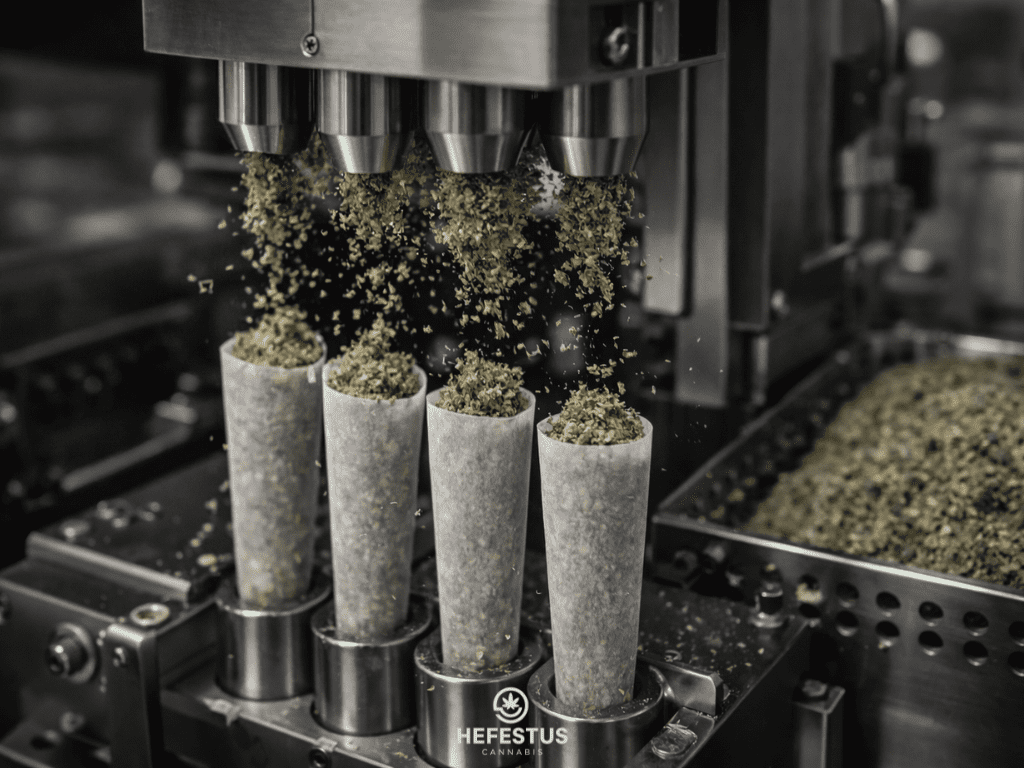
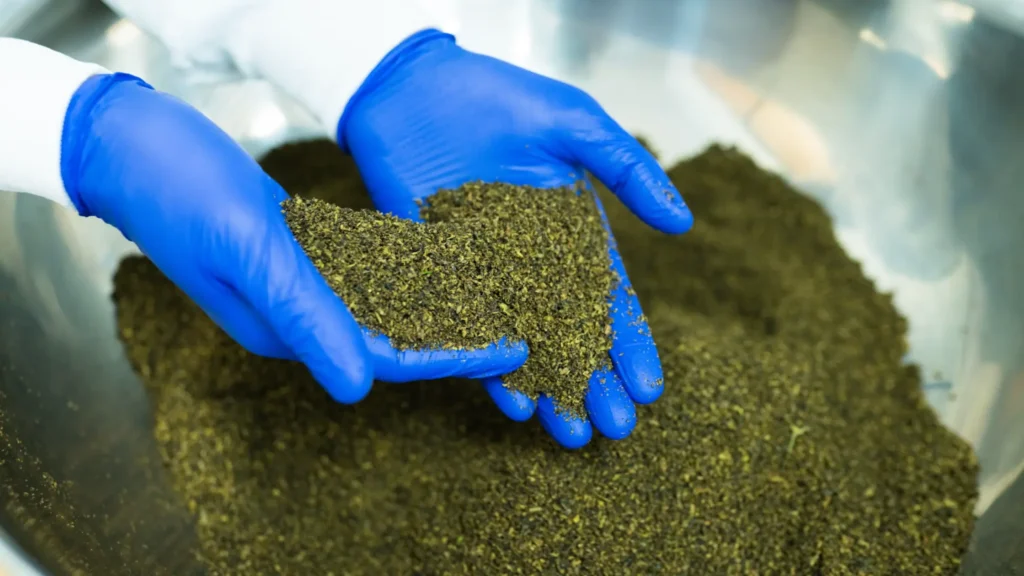
To produce quality at volume, particle size must be engineered upstream through continuous-flow milling, stem control, and predictable distribution—before the material ever reaches a cone.
Packing Density: The Variable That Breaks Everything
Even with a perfect grind, packing density determines how a joint smokes.
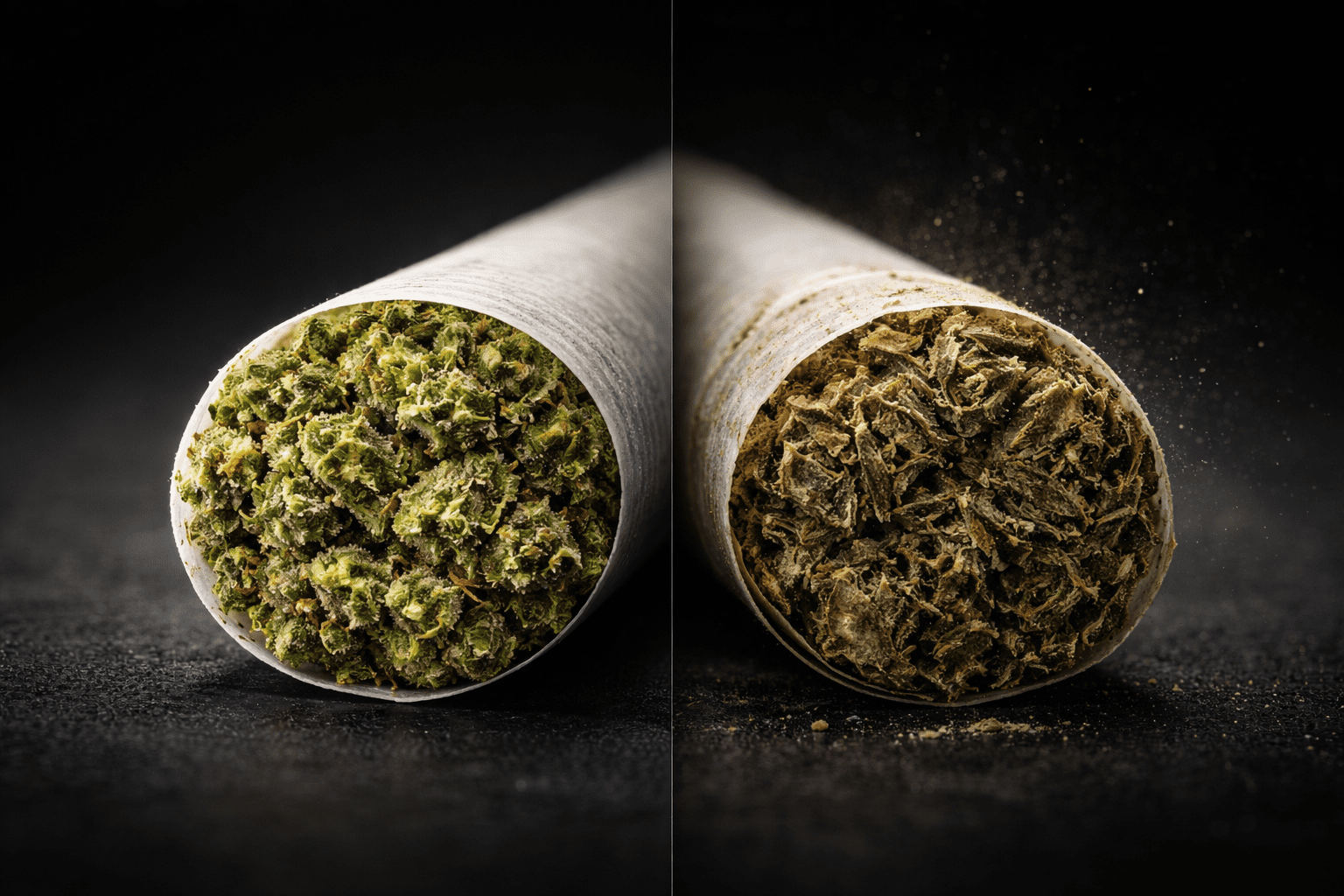
- Overpacked: Tight draw, harsh smoke, ignition problems
- Underpacked: Air pockets, canoeing, structural failure
Density must remain consistent from tip to filter. Variability near the filter causes collapse. Variability in the body causes uneven combustion.
This is where manual production fails first.
No human can tamp material the same way hundreds of times per hour, across multiple shifts, without drift. Fatigue, speed pressure, and operator differences introduce variability that compounds over time.
Why Manual Pre-Roll Production Stops Scaling
As volume increases, manual workflows introduce predictable problems:
- Operator-to-operator variability
- Density drift over shifts
- Inconsistent finishing
- Rising reject and rework rates
- Labor costs that scale linearly with output
Worse, labor cost per unit never decreases. As demand grows, margins compress.
This is why high-volume operators don’t automate to eliminate craftsmanship—they automate to standardize it.
Where Automation Wins (When It’s Designed for Cannabis)
Automation excels at:
- Repeatable fill weights
- Consistent packing density
- Uniform finishing
- High throughput with minimal labor
- Integrated quality checks
But cannabis isn’t a generic bulk material.
Infused blends, sticky flower, varying cone formats, and terpene-rich inputs create challenges that generic filling equipment can’t handle. Systems not designed specifically for cannabis tend to clog, drift, or require constant adjustment.
That’s where purpose-built engineering matters.
How Hefestus Engineers the Perfect Preroll at Scale
ItThe Hefestus AuraX was designed around real production constraints—not lab theory.
It addresses the hardest variables in joint construction:
- Controlled, repeatable packing density across every cone
- Stable airflow paths, even with infused material
- Precise weight control to protect margins and compliance
- Uniform finishing, including the patented Dutch Crown
By standardizing these variables, operators dial in the “perfect preroll” once—and then reproduce it thousands of times per day with minimal labor.
In real-world operations, brands using AuraX routinely reduce preroll labor by up to 90%, while increasing throughput and consistency.
The Final Variable: Time
Even a perfectly constructed joint can fail if it isn’t protected after production.
Oxygen exposure, humidity swings, and handling during storage and distribution all degrade aroma, potency, and burn quality. Without protection, the joint that leaves the line is not the joint the consumer lights.
That’s why Hefestus has expanded beyond production into post-fill preservation, introducing Modified Atmosphere Packaging (MAP) as the next layer of quality control.
MAP replaces oxygen inside sealed packaging with inert gas, stabilizing terpenes, moisture, and structure—ensuring the joint performs the same weeks later as it did on day one.Perfecting the joint is step one.
Preserving it through distribution is step two.
Conclusion: The Perfect Preroll Is Engineered—and Protected
The best joints aren’t lucky. They’re engineered.
They result from:
- Controlled particle sizing
- Consistent packing density
- Stable airflow
- Repeatable finishing
- Scalable automation
- Protection over time
When those variables are controlled, brands deliver a perfect preroll experience consumers trust—and trust is what drives repeat purchases.
Understanding the science is the starting point.
Implementing it consistently—and preserving it to the shelf—is where modern pre-roll production is headed.